

Just-in-Time (JIT) inventory management helps manufacturers reduce excess stock by aligning material and component availability more closely with actual production demand. The goal is simple: keep what you need available when you need it, without tying up unnecessary cash, space, and labor in inventory that sits unused.
For paint, coatings, and chemical manufacturers, that can mean tighter control over raw materials, production supplies, and selected replacement components. But JIT is not the right strategy for every item. Critical MRO parts with long lead times or a high risk of causing production shutdowns often require a different inventory approach.
The strongest inventory strategy balances lean inventory with operational risk, using tools such as JIT replenishment, min-max levels, vendor-managed inventory, stocking agreements, and critical-spares planning.
What Is Just-in-Time Inventory Management?
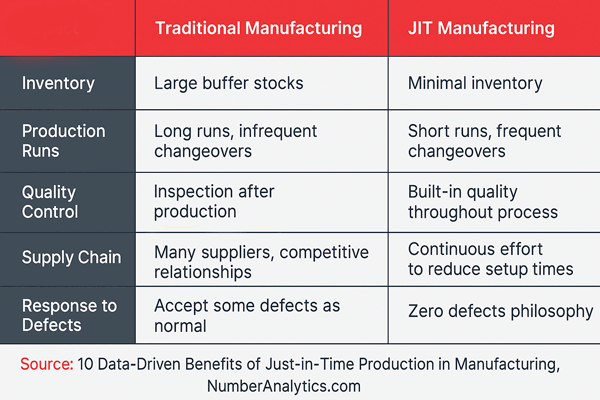
Just-in-Time inventory is a strategy that reduces the amount of material held in stock by timing replenishment more closely with actual production or usage. Instead of keeping large quantities on the shelf, manufacturers receive materials, components, or supplies closer to when they are needed.
JIT can help manufacturers:
- Reduce excess inventory and carrying costs
- Free up warehouse and production-floor space
- Reduce obsolete or aging stock
- Improve inventory visibility and replenishment discipline
- Respond more closely to actual production demand
- Identify which critical items should not be managed as pure JIT inventory
How JIT Inventory Works in Manufacturing
A JIT inventory system attempts to synchronize replenishment with production demand. Instead of purchasing large quantities well in advance, the manufacturer relies on predictable usage, reliable suppliers, accurate inventory data, and consistent lead times.
A typical JIT process may include:
- Forecast or identify near-term production demand.
- Determine the quantity of material or components required.
- Set replenishment points based on actual consumption and supplier lead time.
- Order or replenish inventory closer to the point of use.
- Monitor usage and adjust stocking levels as demand changes.
The approach works best when purchasing, operations, maintenance, and suppliers have reliable information and clear replenishment processes.
Benefits of JIT Inventory Management
Lower Inventory Carrying Costs
Inventory consumes cash before it is used. It also requires storage space, handling, tracking, insurance, and administrative time.
Reducing unnecessary stock can lower those carrying costs and allow manufacturers to invest working capital elsewhere in the operation.
Less Warehouse Space
Large inventories can take up valuable production or warehouse space. A leaner replenishment strategy can reduce the footprint dedicated to stock that may sit unused for long periods.
Reduced Obsolescence and Waste
Some raw materials, consumables, and components can become obsolete, expire, degrade, or simply stop being needed as processes change.
Ordering closer to actual demand can reduce the amount of aging or obsolete material left on the shelf.
Better Alignment with Production Demand
JIT inventory relies on closer coordination between purchasing and actual usage. This can help manufacturers respond to changing production schedules rather than maintaining static stocking levels that no longer reflect demand.
Greater Inventory Visibility
A successful JIT strategy requires accurate usage information. That visibility can also reveal slow-moving items, recurring shortages, unexpected consumption changes, and opportunities to improve replenishment.
Why JIT Inventory Can Also Create Risk
The same lean inventory levels that create savings can also make an operation more vulnerable when something goes wrong.
Common JIT inventory risks include:
- Supplier delays
- Transportation disruptions
- Unexpected increases in demand
- Incorrect usage forecasts
- Long or variable lead times
- Single-source components
- Unexpected equipment failures
If there is little or no safety stock, a delayed shipment can quickly become a production problem.
JIT Inventory vs. Critical MRO Spare Parts
This is one of the most important distinctions for industrial manufacturers.
Raw materials and regularly consumed production supplies may be good candidates for lean or JIT replenishment when usage and lead times are predictable.
Critical maintenance, repair, and operations (MRO) parts are different. A single missing valve, actuator, filter, seal, bearing, motor, or other component can sometimes stop an entire production process.
| Inventory Type | JIT Fit | Key Consideration |
|---|---|---|
| Predictable production materials | Often a strong fit | Demand and lead time must be reliable |
| Regular consumables | May be a strong fit | Usage data should drive replenishment |
| Common MRO parts | Depends on availability | Lead time and local supplier stock matter |
| Critical spare parts | Often poor fit for pure JIT | Downtime risk may justify keeping stock available |
| Long-lead or single-source parts | Higher risk | Stocking agreements or critical spares may be safer |
A better approach is often to segment inventory based on operational risk rather than apply the same JIT strategy to every item.
>> Learn more about spare parts and MRO inventory management
JIT Inventory in Paint and Chemical Manufacturing

Paint, coatings, and chemical manufacturing can be particularly sensitive to inventory timing because production often depends on coordinated access to raw materials, filtration components, valves, actuators, seals, and other process equipment.
When a required item is unavailable, the consequences may include:
- Delayed production batches
- Emergency freight and purchasing costs
- Extended equipment downtime
- Changes to production schedules
- Quality problems if processes are interrupted or modified
- Delayed customer shipments
For that reason, inventory strategy should account for both the cost of carrying an item and the operational impact of not having it.
>> Minimizing Downtime and Ensuring Quality in Paint Manufacturing
How to Decide Which Inventory Should Be JIT
Before reducing an item's stocking level, evaluate the consequences of a stockout.
Consider:
- Usage frequency: How often is the item consumed or replaced?
- Lead time: How long does replenishment actually take?
- Lead-time variability: Is delivery consistently predictable?
- Downtime impact: What happens if the item is unavailable?
- Substitutes: Is an equivalent component readily available?
- Supplier availability: Is the item stocked locally or only made to order?
- Storage cost: How much space and working capital does the item consume?
- Shelf life: Can the material deteriorate or expire?
Items with predictable usage and dependable replenishment are generally better JIT candidates than items with long lead times and high downtime consequences.
JIT, Min-Max, VMI, and Stocking Agreements
JIT is only one way to manage industrial inventory. Depending on the item and risk level, manufacturers may use several approaches together.
| Approach | How It Works | Best Use |
|---|---|---|
| JIT | Replenishes closer to actual need | Predictable demand and reliable supply |
| Min-Max | Triggers replenishment when stock reaches a defined minimum | Frequently used MRO and production items |
| Vendor Managed Inventory | Supplier monitors usage and replenishment levels | Reducing internal inventory-management workload |
| Stocking Agreement | Supplier reserves or maintains agreed inventory | Critical or longer-lead components |
MCE's inventory management programs include Vendor Managed Inventory (VMI), Customer Managed Inventory (CMI), and stocking agreements. These programs use replenishment triggers, usage data, and planned stocking levels to help manufacturers reduce stockouts without simply overfilling shelves.
MCE and Nightwine Support Paint and Chemical Manufacturers
Nightwine Valves & Actuation, an MCE company, supports paint, coatings, and chemical manufacturers with valves, actuation, filtration, instrumentation, technical support, and service.
Current Nightwine capabilities include products from manufacturers such as Parker and Flowserve, plus in-house and field support for valve actuation, control valve repair, instrumentation, calibration, troubleshooting, and preventive maintenance.
That product and service access can be combined with MCE inventory-management programs to help customers develop stocking strategies around actual usage, lead time, and equipment criticality.
Success Story: Solving a Paint Filtration Bottleneck

A global automotive and industrial coatings manufacturer was experiencing recurring filtration problems that contributed to equipment downtime, reduced product quality, and material waste.
Nightwine engineers reviewed the application and worked with Parker Hannifin on a filtration solution matched to the operating conditions. The team also supported installation and testing.
The documented project results included:
- Elimination of the recurring filtration failures addressed by the project
- Reduced unplanned downtime
- Improved product quality
- Reduced waste and maintenance requirements
- Expansion of the approach to additional production locations
The example illustrates why inventory and equipment strategy are closely connected. Having the correct component available matters, but so does selecting the correct component for the application in the first place.
Read the full paint production success story.
How to Build a Leaner Inventory Strategy Without Increasing Downtime Risk
The objective is not to minimize every inventory level. It is to maintain the right inventory for the operational risk.
A practical inventory review should:
- Identify critical production and MRO items.
- Review actual consumption and historical usage.
- Document supplier and manufacturer lead times.
- Estimate the downtime impact of a stockout.
- Separate predictable JIT candidates from critical spares.
- Set replenishment triggers or min-max levels where appropriate.
- Use supplier stocking agreements for selected high-risk items.
- Review inventory data regularly as production requirements change.
Improve Inventory Availability with MCE
JIT inventory can reduce excess stock, but industrial inventory management works best when stocking decisions account for production demand, supplier lead times, and the cost of downtime.
MCE helps manufacturers build inventory programs using Vendor Managed Inventory, Customer Managed Inventory, stocking agreements, dynamic replenishment levels, and critical-parts planning.
Explore MCE inventory management solutions or contact MCE to discuss an inventory strategy for your facility.