


For manufacturers in industries ranging from aerospace and metal fabrication to plastics, food production, paper mills, and logistics, workplace safety is a daily responsibility.
Yet even with established safety procedures and protective measures in place, workers still face hazards from heavy machinery, moving equipment, and busy production floors.
In 2024, U.S. employers reported 306,500 nonfatal workplace injuries in the manufacturing sector, according to the U.S. Bureau of Labor Statistics.
Across all industries, BLS data from 2023–2024 shows that overexertion and repetitive motion were among the leading causes of injuries and illnesses resulting in days away from work, restricted duty, or job transfers. Contact incidents, including workers being struck by objects or equipment or caught in machinery, accounted for 860,050 cases over that two-year period.
Established safety practices and protective measures remain essential. But manufacturers also need ways to identify hazards before an incident occurs, monitor how employees interact with equipment, and respond quickly when conditions become unsafe.
Some products and systems are truly safety rated and conform to existing safety standards and/or protocols. Others may not meet those safety standards (e.g. new artificial intelligence monitoring systems), but they do capture and provide data for operators, engineers, and management that allows for the identification and understanding of previously unseen dangerous operations, practices, and situations. These can then be acted upon or modified to eliminate those dangers.
Smart technologies can help manufacturers strengthen these protections. From safety sensors and LiDAR systems to intelligent actuators and AI-powered monitoring, these technologies can detect hazards, trigger protective responses, and help reduce the risk of workplace injuries.
 Smart Automation Safety Technologies
Traditional manufacturing safety measures have long relied on physical barriers like fencing, cages, and machine guards. Those measures remain important, but there have been significant advancements in robotics, sensors, control systems, and artificial intelligence that help manufacturers identify and respond to hazards.
These technologies detect when someone approaches a dangerous machine and either trigger a controlled slowdown, stop equipment when necessary, or alert supervisors of unsafe conditions. Responses can be triggered based on the application, the hazard involved, and the safety system’s design.
Related: Automation in Manufacturing Without Starting Over
Manufacturers can add them to existing machines at relatively low cost. Here are just a few examples of smart factory automation:
Safety Light Curtains
Safety light curtains create an invisible barrier of light around a hazardous area. When a person or object interrupts the infrared light beams with hands or fingers, the system will send a signal to the machine’s controls to prevent startup or initiate a safe stop, depending on the application.
Useful around:
- Presses
- Robots
- Stamping machines
- Automated production equipment
- Injection molding and plastic forming machines
- Heavy equipment
Safety light curtains reduce the risk of injury that may occur if a person’s hand or other object accidentally enters a protective zone.
These are not a replacement for physical guards; they’re an added layer of protection to prevent access to dangerous in-motion tasks.
Intelligent Actuators offer a safety controller used with safety light curtains or safety LiDAR sensors to change how the actuator behaves when someone approaches a hazardous area.
Here’s a simple example:
- LiDAR or safety curtain detects proximity when someone or something enters a defined area
- Safety sensor sends signal to the actuator which in turn slows movement to reduce forces as a safety response
- The actuator senses force and stops: If someone touches the moving actuator, it senses additional torque and stops, preventing hand injuries from pinch points
LiDAR & Safety Laser Scanner Sensors
These sensors use laser-based scanning to detect objects and measure their distance from a sensor. In industrial environments, safety-rated scanning systems can monitor designated areas around machinery, equipment, or collaborative robots.
These are useful for configuring different responses to match the need without engaging an all-or-nothing intervention. For instance, a Safety Laser Scanner system might:
- Trigger a warning like a flashing light or loud noise when someone approaches.
- Slow equipment as the person or object gets closer.
- Stop the machine if a person enters a critical zone.
Multiple safety laser scanners can be linked together to create a full protection zone completely around a large piece of equipment when a single sensor is not enough.
LiDAR is used with autonomous mobile robots (AMRs). Where previous generation systems may have followed a fixed magnetic strip or waypoint marked route, LiDAR-equipped robots can detect objects in their path. They can slow down, stop, or navigate around an obstacle to reduce the risk of accidental contact.
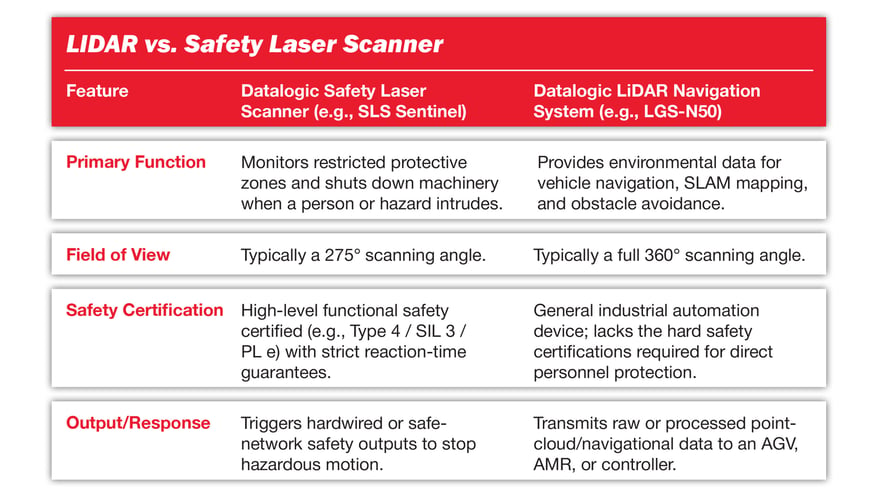
LiDAR and Safety Laser Scanners both share the same core underlying physical technology — time-of-flight (ToF) infrared laser ranging — but they are engineered, certified, and programmed for entirely different operational purposes.
How LiDAR and Safety Laser Scanners Compare
- Laser Ranging Principle: Both emit pulses of infrared laser light and calculate distance by measuring the time it takes for the light to bounce back from an object (time-of-flight).
- Optical Components: Both use rotating or scanning optical mirrors and photodiodes to sweep laser beams across a physical plane.
See Datalogic Safety Laser in Action
Collaborative Robots
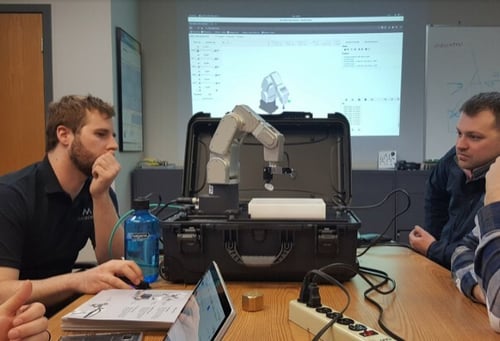
Collaborative robots, or cobots, are designed to support applications where people or other robots are working alongside without the need for a conventional industrial robotic safety cell.
These reduce repetitive strain and potential hazards in:
- Repetitive assembly
- Machine tending
- Material handling
Instead of workers having the added pressure of ergonomic strain and hazardous handling tasks, they can focus on other work that requires judgement, oversight, and specialized skills.
While cobots can be programmed for power limits, speed monitoring, and other safety functions that manage contact and movement, a complete risk assessment should be completed to determine the required guarding and protocols required for operator interactions and safety. We advise considering the tools attached to the robots, the workpiece involved, the robot’s speed, and pinch points that could introduce additional hazards.
AI-Powered Systems
Artificial intelligence improves a manufacturing facility’s ability to monitor activity for safety-related concerns. Camera-based and sensor systems can be configured to identify potentially hazardous conditions or activities, such as:
- A person in the travel area of a forklift
- A vehicle traveling too fast
- Employees entering designated zones without proper PPE
(Source: Detect-It)
These AI-powered safety systems can notify supervisors, activate warning lights, and provide records of recurring events. Over time, safety and operations teams can identify patterns that may otherwise go unnoticed.
Recurring alerts may prompt a review of:
- Traffic routes
- Work procedures
- Training needs
Armed with this data, organizations can improve safety programs and identify risks before they result in injury.
Machine-Vision and Inspection Systems
Machine vision uses cameras and processing technology to inspect products, components, and processes. Depending on the application, machine vision systems can identify defects, verify component placement, check dimensions, and detect unsafe or unusual conditions that don’t meet defined requirements.
How else can these improve safety?
Automated inspection can reduce the need for workers to handle parts repeatedly or perform manual inspections near moving machinery. Not only can this technology reduce the likelihood of an employee encountering hazards like pinch points, but they also reduce ergonomic strain.
Note: Not every camera or AI-powered system is designed or certified to perform protective safety functions. Be sure to check with your supplier if a machine vision system is designed for quality inspection or is safety-rated.
Standard IO Connections vs. Redundant Safety Systems
A sensor alone doesn’t make a machine safe. Connecting a safety sensor to a machine’s standard input/output is not always enough to ensure a safe response. If a standard signal fails or becomes stuck, the machine may not stop as intended.
Safety applications require appropriately rated control circuits and safeguards designed for the specific hazard. We recommend having redundancies in place to help ensure a single failure doesn’t compromise safety.
Think of this as a safety net. Design, integrate, and validate the entire protective system, not just the sensor itself.
Start with a Manufacturing Safety Assessment
One of the most important steps in a smart automation project is identifying what could go wrong before selecting equipment. Industrial Control, an MCE company, evaluates your needs by discussing your applications and processes, observing how people move around your facility, identifying potential failure points, and conducting a safety analysis.
Whether the project is a major automation overhaul or a smaller equipment upgrade like a sensor or safety device, we recommend asking:
- What hazard are we trying to control? (machine, movement, interaction, level of risk)
- Who could be exposed? (operators, technicians, engineers, material handlers, passersby)
- What response is required? (prevent startup, stop movement, slow down, restrict access, alert supervisor)
- Will the system remain safe if failure occurs? (redundant circuits, appropriate components, tested integration)
- Can the solution work with existing equipment? (can safety device be added or will redesign be necessary)
- How will success be measured? (establish baseline, track indicators like near misses, downtime, ergonomic issues, recordable injuries)
MCE’s Smart Factory Automation Offerings & Services
Industrial Control, an MCE company, supports factory automation applications with robotics, machine vision, sensors, safety, motion control, conveyors, traceability, controls, engineered support, PLCs, and HMIs. We can also supply safety fences, wire racks, weight systems, and light barriers.
Download Now: Smart Factory Solutions (PDF)
Talk to us today to learn more about implementing smart factory solutions in your facility.