
For manufacturers, automation makes sense. Yet many facilities face a dilemma. Existing systems may still function mechanically. Replacing everything from the ground up can be expensive, disruptive, and, in some cases, unnecessary.
Fortunately, targeted retrofits, intelligent upgrades, and smart add-ons to your existing systems can offer the benefits of automation – without a rip-and-replace approach.
When mechanical and structural components of a system are still sound, you don’t need a complete overhaul. What's missing is modern controls, data access, and connectivity.
How Smart Automated Retrofits and Upgrades Extend the Life of Industrial Systems
 While it may be the best choice in some cases, a complete rip-and-replace does come with drawbacks:
- High capital costs for new equipment and infrastructure
- Extended downtime that interrupts production or service
- Risk of integration issues with existing systems
- Loss of long-term knowledge from legacy processes
These factors may cause companies to hit the brakes with automation. But not all automation has to be overly complicated, and these benefits can be reaped at all levels and budgets:
- Increased productivity and throughput
- Improved quality and consistency
- Reduced training time
- Enhanced safety and ergonomics
- Better data and decision-making
- Scalability without disruption
- Lower long-term operating costs
- Competitive advantage
Maybe you just need an actuator to support tedious, manual processes such as moving, grabbing, or filling. Or you need a custom conveyor to move items between workstations. Retrofits and automation upgrades can be implemented incrementally and cost-effectively as business needs change.
The following modernization strategies – retrofits, upgrades, and add-ons – focus on maximizing the value of current assets while reducing disruption, capital expense, and implementation risk.
Check out MCE's Library of Automation Resources
High-Impact Automation Retrofits for Existing Manufacturing Systems
 A retrofit replaces, adds, or enhances components, such as controllers, sensors, drives, or operator interfaces, while leaving existing systems intact. This helps businesses modernize in phases, reducing costs and risk.
Common retrofit opportunities include:
- Upgrading human-machine interfaces (HMIs) for clearer visualization and easier operation.
- Replacing obsolete programmable logic controllers (PLCs) or relay-based controls with modern programmable platforms.
- Smart tool integration, retrofitting manual tools with torque-controlled, connected tools.
- Improving operations for motion control, precision, and repeatability in manual processes.
- Conveyors, robotics, or cobots (collaborative robots) to automate material handling, assembly, or packaging.
- Replacing manual inspection methods with camera-based vision systems for quality checks, dimensional accuracy, and precision.
- Implementing systems to automatically collect production data (cycle times, capacity, unit counting).
- Adding modern safety controls to meet current safety standards.
Related: 7 Steps to Modernize Your Plant Safety
Industrial System Upgrades for Connected Operations
While retrofits focus on hardware, upgrades address capability and performance. By updating firmware, software, and control systems, you can breathe new life into existing equipment and systems. Upgrades can include anything that breaks down data silos and allows for real-time visibility, automated data flow and increased efficiency.
Examples can include:
- Migrating from proprietary or unsupported software to modern platforms.
- Implementing advanced controls for efficiency and consistency.
- Integrating systems into plant-wide SCADA (supervisory control and data acquisition).
- Enabling remote access, diagnostics, and support.
These upgrades can turn isolated machines into connected assets. With the right partner, you can adopt automation one step at a time, instead of all at once.
Smart Add-Ons That Enhance Capability Without Re-Engineering
One of the most powerful ways to modernize manufacturing operations is to use smart add-ons. Smart add-ons are enhancements that can add new capabilities to an existing system without major rework. They often work by improving function and communication between existing tools, actuators, and assembly processes.
Instead of replacing mechanical elements that already exist, such as motors, actuators, conveyors, and assembly tools, add-ons make them smarter.
Here’s an example:
In automotive manufacturing, a vision system tracks the position of a smart fastening tool in real time. It only activates when it is placed on the correct bolt and used in the proper sequence, such as following a star pattern when mounting a wheel. The tool itself monitors and verifies that each fastener is tightened to the approved torque levels, helping drive safety and quality for customers. If the operator attempts the wrong sequence, the system requires them to back out and retry the step before proceeding.
Smart add-ons offer:
- Reduced employee training time and faster onboarding
- Lower error rates and improved consistency
- Embedded safety features that protect workers
- Real-time confirmation that each step was correctly completed
By pairing intelligent tools with vision systems and existing equipment, manufacturers can improve reliability and efficiency without redesigning their entire operation.
Factory Automation Doesn’t Have to Be All or Nothing
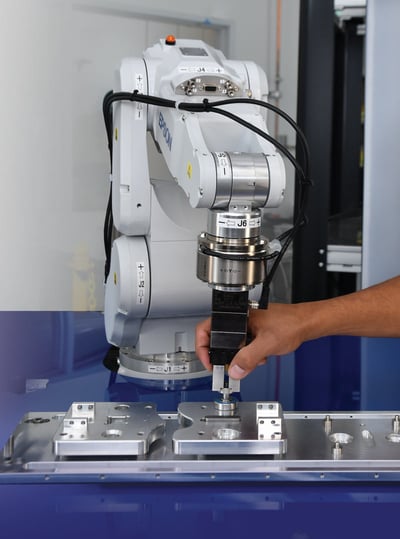 One of the most common barriers organizations face is the misconception that automation means jumping straight to full-scale robotics.
Modernization in your manufacturing operation doesn’t have to be all-or-nothing. You can align automation and upgrades with your operational goals, budgets, and risk tolerance.
For example, advanced robotic arms may be part of your long-term plan. But you can’t do it now. So, instead of an $8,000-$20,000 robot, your operation may benefit from a $2,000 actuator that handles up and down movement.
Other examples may include:
- Flexible robotics now handle high-speed assembly, material handling, and precision welding. Industrial robots manage repetitive tasks at scale, while cobots work safely alongside employees. Our partner Epson offers:
- SCARA Robots
- 6-Axis Robots
- All-in-One Series Robots
- Cobots, which ease physical strain and boost safety
- Vision systems for quality control inspect parts at high speeds, detecting defects, verifying assemblies, and ensuring product conformity. These systems improve accuracy and reduce human error.
- Smart fastening tools like fixtured screwdriving systems and smart assembly tools are optimized for high speed and accuracy, automating labor-intensive processes.
- PLCs enable flexible, easily reprogrammable automation that supports 24/7 reliability and adapts to product changes without major downtime.
- Industry 4.0 and IIoT enable real-time monitoring and predictive maintenance with cloud-connected systems and smart sensors.
Related: Automation for Modern Manufacturing
Real World Use Cases of Automation in Action
Creating Savings with a Machine Center Controls Upgrade
A company’s machining center had a 20-year-old control system that was no longer operational, even though the machine’s mechanical components could still produce quality parts. Replacing the machine would have been costly.
MCE’s team retrofitted the machine by rebuilding the control cabinet, and installing new controls, motors, and drives. We also converted the old PLC program to a modern controller with updated drives. This kept the usable mechanical system intact while upgrading the automation and control hardware.
Results:
The machine was restored to “like new” operational status, saving the customer the expense of a new machining center. This improved reliability, organization, and performance.
Cost-Effective Robotics in Medical Device Manufacturing
In the medical device space, MCE partnered with an integrator on a project using compact Epson SCARA robots, an accessible alternative to large, complex robotic cells. These robots were tasked with simple, repetitive motions such as picking and placing medical vials into pucks moving along a conveyor line.
By combining robotics with conveyors, actuators, vision systems, and safety sensors, the solution created a collaborative environment. Robots automatically slowed or stopped when a human entered the workspace, allowing operators to safely interact with the process.
Results:
- Increased throughput without sacrificing safety
- Consistent handling and placement of delicate components
- Scalable automation achieved at a manageable investment level
Targeted robotics retrofits can deliver high value without the cost or complexity of full-scale automation.
MCE’s Automation Retrofit Services for Manufacturing Plants
MCE helps you evaluate where you are today and what the most practical entry point to automation is based on your current and future goals. This evaluation typically includes:
- Understanding the pain point that triggered the need for automation
- Assessing existing equipment to see what can be reused or enhanced
- Connecting the right technical resources from technical engineers and automation partners
- Collaborating with you to brainstorm solutions, troubleshoot, and address challenges
Sometimes, the solution is simple. Other times, it can evolve into a more comprehensive strategy. Either way, we’re right there with you.
MCE approaches retrofits and upgrades by evaluating the whole system, not just swapping out parts. We focus on the connections and relationships within the system to engineer solutions that improve performance, reliability, and long-term maintenance.
We believe retrofit success depends on these key factors:
- Close collaboration with technical partners to address root causes and real-world challenges.
- Use of stocked, certified components that meet strict operational and environmental standards.
- Designing durable hardware that resists corrosion, tampering, and meets shock/vibration requirements common in manufacturing.
- Incorporating user and field-testing feedback throughout design and testing phases.
- Ensuring solutions support both retrofit and new construction with proper documentation and inventory.
- Fast, focused problem-solving to deliver lasting fixes in harsh or demanding environments.
- Preventative maintenance programs that spot and address inconsistencies early on.
Contact us today to explore how we can engineer modern automated solutions tailored to your operation.
Research from RobCo’s 2025 U.S. Automation Readiness Index shows 95% of U.S. industrial manufacturing firms plan to introduce automation over the next three years. About one-third of companies surveyed already use robots, and more than 50% are testing or planning robotic integration.
That tracks with reports from ABI Research; they estimate the global robotics market is up 11% from 2024 and on pace to reach $111 billion by 2030.
Why the sudden push?
Respondents said federal incentives and reshoring initiatives were main drivers for automation adoption. On the other hand, many manufacturers are interested in automation but say high upfront costs and skills shortage remain key barriers.
Don’t let fear of the unknown hold you back. Talk to an MCE automation expert today to see how automation can fit in your business and budget.