
Hose assemblies are among the hardest-working components in a facility.
It doesn’t matter if they are transferring hydraulic fluid, compressed air, steam, chemicals, petroleum, water, or food-grade material. They vibrate, flex, withstand pressure cycles, and operate in demanding environments where failure can be dangerous.
An unexpected hose failure can expose employees to high-pressure fluids, steam, chemicals, or compressed air. It can damage equipment, halt production, contaminate processes, cause environmental damage, and lead to expensive and unplanned downtime.
Many businesses focus on hoses once the damage is done. A better way? Understanding how hose assemblies should be built in the first place.
 Think of Your Hose Assembly as an Engineered System
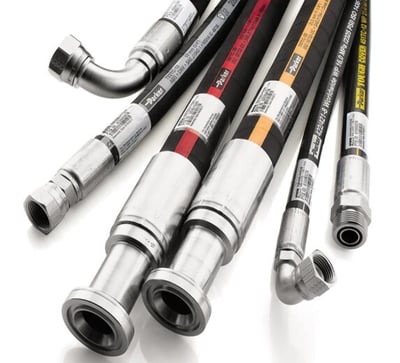
It’s tempting to think of a hose assembly in simple terms: the individual components that fit together. Hose. Fitting. And the machine that crimps them together. When one goes bad, swap it out with a similar part. It’s common practice. But in reality, manufacturers have very different specifications when it comes to engineering hose components, along with different testing and certification methods.
Depending on the application, testing may evaluate pressure ratings, flexibility, temperature, chemical compatibility, vibration, and long-term durability. The results of this testing apply to the entire system, not just the hose itself.
Manufacturers’ hoses, fittings, and crimp specs are designed to work together as complete systems. When one component in that system changes, the performance of the whole assembly changes.
ParkerStore: MCE Customer-Focused Hose & Fitting Supply and Service
Why You Shouldn’t Mix Hoses, Fittings, and Crimpers from Different Manufacturers
At first glance, various hose components look similar. The hose sizes are right, the fitting threads are correct, and they fit together without difficulty. But compatibility involves more than fit.
Manufacturers use different fitting geometries, stem designs, materials, tolerances, and crimp specifications that are developed through laboratory testing and field validation to ensure safe, reliable performance.
These differences are intentional and help maintenance teams:
- Reduce likelihood of premature hose failure
- Improve worker safety
- Increase assembly consistency
- Extend service life
- Support compliance with manufacturer recommendations
- Improve maintenance and inspection consistency.
That’s why we recommend using manufacturer-approved hose systems rather than treating hoses, fittings, and crimping equipment as components that can be interchanged.
When incompatible components or assembly specifications are used, the risk of hose assembly failure increases. And the kicker? Taking shortcuts might not become apparent until weeks or months later, usually when the last thing you need is an unplanned shutdown.
Important note: Using component combinations that are not approved by the manufacturer may place responsibility for validating the assembly and application on the assembler or user.
Small Hose Assembly Errors, Big Consequences
An improperly assembled hose can fail in ways that endanger people, equipment, production, and the environment. A few examples include:
- Hydraulic: Risk from fluid injection injuries, hose whip, loss of machine control
- Steam: Severe burns from escaping steam
- Chemical: Chemical exposure, environmental release, corrosion
- Compressed Air: Hose whip, flying debris, stored energy release, accidental cuts or abrasion
- Petroleum: Fire hazards, spills, environmental contamination
- Food Processing: Product contamination, sanitation issues
Best Practices for Safer Hose Assemblies
- Treat hose assemblies as complete engineered systems rather than individual parts.
- Use hoses, fittings, and crimping equipment approved to work together.
- Follow manufacturer-published assembly and crimp specifications.
- Inspect and calibrate crimping equipment on a regular schedule.
- Verify crimp dimensions and fitting tolerances during assembly.
- Maintain traceability for every hose component.
- Train technicians on proper assembly, inspection, and installation procedures.
- Investigate hose failures to identify and correct the root cause instead of just swapping out parts.
The Importance of Maintaining Traceability in Hose Assemblies
The risks of mixing hose and fitting brands extend beyond compatibility and performance. It can also make it harder to maintain a traceable record of the components used in an assembly. Asset tracking programs store important information about components in an assembly:
- Sizes, types, and applications
- Pressure ratings and testing requirements
- Material compliance
- Certifications and labels
Programs also help with recall management if parts are found to have defects, especially important for businesses subject to recalls or liability.
- Ensure quality and safety
- Enhance supply chain visibility
- Meet regulatory compliance and sustainability initiatives
When a manufacturer can trace quality issues to the root source, they can take corrective actions sooner, protecting customers from unexpected equipment failures.
Traceability depends on knowing exactly which components make up an assembly and how those components were designed, tested, and validated together. When hoses and fittings from different manufacturers are mixed, that chain becomes harder to follow. The result is more uncertainty around compatibility, performance, and accountability.
The Parker Tracking System records, retrieves, and manages hose assembly data to support identification, replacement, inspection, and maintenance planning. Ask your MCE rep for details.
Why Crimping Equipment Matters Just as Much as Hose Selection
Safe hose assemblies depend not only on selecting the correct hose and fittings but also on using the proper assembly equipment.
Every manufacturer develops crimp specifications based on approved tooling, dies, and machine calibration. A crimp that falls outside those specifications may look acceptable but may not achieve the retention strength or sealing performance required for safe operation.
Using crimping equipment from another manufacturer introduces variables that cannot be verified against the manufacturer's testing.
Here’s an example when it was the crimping equipment’s fault, not the hose:
During one MCE customer visit, we were asked to evaluate what appeared to be a defective hose. The customer had experienced repeated failures and blamed the hose. Upon inspection, the MCE rep noticed an issue with the customer’s crimping equipment.
The crimping machine was not bottoming out correctly, producing crimps outside the manufacturer’s specifications. The fitting tolerances were not routinely verified after assembly either.
Once we addressed the crimping issue, the recurring failures stopped. Sometimes, it’s not just about replacing a failed hose. Sometimes, you need to look at the entire assembly to treat the problem.
Hose and Fitting Support from MCE
MCE ParkerStores provide Parker hose, fittings, custom hose assemblies, crimping equipment, and support for selecting compatible components. Whether you need replacement components or help improving your hose assembly process, our team can help.
