
One of the biggest conveyor design challenges is deciding where the conveyors need to go next.
Whether routing cartons to different packing stations, shipping lanes, or production cells, transfer points are often where congestion, maintenance demands, and the need for future flexibility become most apparent.
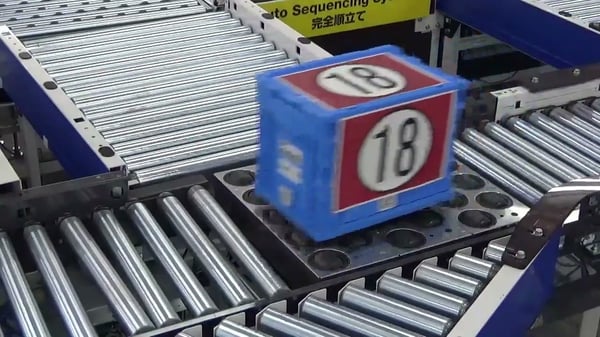
Ball sorters solve that by using powered transfer balls to provide flexible, multi-directional transfers within a compact footprint. Unlike fixed-angle transfers or pop-up diverters, the system can route products to multiple destinations from a single zone.
Using motorized roller technology instead of pneumatic actuators eliminates compressed air requirements and enables precise, programmable movement.
Ball sorters are commonly used to:
- Route orders to multiple packing stations
- Divert cartons by shipping carrier or destination
- Feed multiple production or assembly lines
- Consolidate products before palletizing
- Direct totes to different fulfillment zones
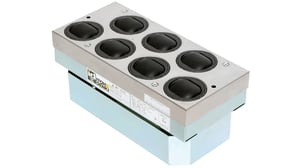 One example is the Itoh Denki Multi Angle Ball Sorter (MABS2), available from Ultimation, an MCE company. The modular system uses the company's 24V motor-driven roller (MDR) technology instead of pneumatic diverters to create programmable, multi-angle product transfers. Modules can be combined to accommodate larger products or higher throughput, making it easier to add flexible routing capabilities within a compact footprint while allowing conveyor systems to expand or adapt as operational requirements evolve.
When a Ball Sorter Is a Good Fit
Ball sorters are most valuable when versatility is more important than maximum throughput.
Multi-directional routing
Some applications require products to travel to several downstream destinations. Instead of designing multiple dedicated transfer points, one ball sorter can route products in different directions based on system logic. This simplifies conveyor layouts while making future changes easier.
Limited floor space
Facilities often need to add functionality within an existing footprint. Because ball sorters combine multiple routing capabilities into a compact module, they can help maximize available space without requiring extensive conveyor modifications.
Layouts expected to change
New customers, seasonal demand, changing product mixes, and additional fulfillment channels can all change material flow. Flexible routing allows conveyor systems to adapt without requiring major mechanical changes.
For example, an ecommerce fulfillment center may initially route cartons to four packing stations. As order volume grows, additional packing lanes are added and shipping workflows change. A modular ball sorter allows routing logic to be updated and additional transfer modules incorporated without redesigning the entire conveyor layout.
Continuous product flow
Stopping products before transferring them can create small delays that add up over thousands of packages. Ball sorters maintain continuous movement through the transfer process, reducing interruptions while supporting smooth product flow.
When a Ball Sorter May Not Be the Right Choice
In some situations, a different solution may deliver better performance or a lower total cost.
Simple point-to-point transfers
If products only need to move from one conveyor to another at a fixed angle, a traditional transfer or pop-up diverter may provide the same functionality with less complexity.
High-throughput applications
Facilities moving high volumes through a consistent, repeatable routing pattern may benefit from sortation technologies designed for maximum throughput. Ball sorters prioritize routing flexibility over sorting speed.
Products that don't transfer well
Ball sorters perform best with products that have a stable, relatively flat conveying surface. Very small items, irregularly shaped products, or loads with unstable bottoms may require alternative transfer methods to maintain reliable movement.
Applications with little expected change
If routing paths are unlikely to change throughout the life of the system, investing in a highly flexible transfer solution may provide capabilities that are never fully utilized. Fixed routing solutions can sometimes offer a more economical approach for stable production environments.
The best transfer technology depends on the products being conveyed, required throughput, available space, and how much flexibility the operation is likely to need in the future.
Questions to Ask Before Selecting a Ball Sorter
Like any automation investment, selecting the right transfer technology begins with understanding the application. Ask:
- How many destinations will products reach?
- Will routing requirements change over time?
- Is floor space limited?
- Are compressed air systems already available, or would eliminating them simplify maintenance?
- What product sizes, weights, and package characteristics will be conveyed?
- What throughput is required today, and what will it likely be in five years?
As fulfillment operations evolve, conveyor systems need to evolve with them. Transfer technology should support changing product flows rather than lock facilities into fixed routing paths.
Need help determining whether a ball sorter is the right fit for your application? The material handling experts at Ultimation can evaluate your product flow, routing requirements, and available space to help you select the right transfer solution. Contact us to discuss your application or learn more about the Itoh Denki Multi Angle Ball Sorter.