
Some ideas are so good for flow, they seem inevitable in retrospect. This is especially true if they apply a little out-of-the-box creative thinking to a long-standing pain point — like luggage with wheels or self-sealing envelopes.
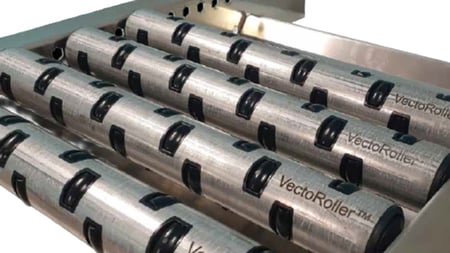 For warehouse conveyor systems, VectoRollers™ are a great example of this kind of design breakthrough. It provides an easy, affordable way to minimize the friction that arises when workers need to move products laterally, against the main direction of the conveyor.
By incorporating mini-rollers that run perpendicular to the conveyor’s main direction, VectoRollers™ allow items to easily slide in a lateral direction.
In fact, the VectoRoller™ lateral conveyor design reduces up to 80% the amount of force that’s needed to move packages laterally, compared with regular conveyor systems.
That ergonomic improvement means less strain and fatigue for operators, while allowing packages and products to go with the flow, instead of struggling against it.
The Trouble with Conventional Conveyors for Lateral Movement
Most warehouse conveyors are designed to move product efficiently along a straight line in a single direction. But warehouse reality isn’t always linear. There are times when products need to be intercepted and moved laterally such as at packing stations, quality control checks, and other secondary processes. Items may also need to be repositioned to align with scanners or other equipment.
Traditional conveyor rollers offer significant resistance to sideways movement, making the process harder than it needs to be. Generally, this means extra effort is required at pick, merge, and sorting points.
For warehouse workers, trying to move product against the main flow can be like swimming against a current. Lifting, pushing, or pulling products to move them laterally causes strain, fatigue, and stress. In addition to causing a slowdown in momentum and creating a drag on productivity, this can raise the risk of damage to products and injury to employees.
The impact is magnified given the speed at which modern warehouses need to move, due to higher volumes, mounting competition, and increased demands from customers — as well as the challenges of recruiting and retaining qualified team members in times of labor scarcity.
Why Some Lateral Conveyor Solutions Fall Short
1. A ball transfer table (or ball transfer unit system) is a material-handling surface made up of many small, load-bearing balls that are mounted inside larger housings. Each unit contains a large main ball that sits on smaller support bearings, which allow it to rotate freely in any direction.
The catch is that this approach works best with rigid, flat-bottomed products. It’s less effective for packages with soft undersides or uneven surfaces, and very small items can be problematic as well.
Ball transfer tables are also vulnerable to dirt and debris, which can adversely affect performance. And it’s less than ideal when you need a controlled directional flow, since it allows items to move in any direction rather than just one specified counter-direction.
2. A pop-up transfer station consists of a powered conveyor mechanism that’s used to move products from one conveyor line to another, either at a right angle or moving in a different direction. These are often used in automated sorting systems, for diverting products to different lines, or when changing directions in high-throughput systems.
The main issue here is cost, because pop-up transfer stations tend to be expensive. And they still don’t provide the degree of ease and flexibility that’s needed to boost productivity and keep up with demand.
Rugged and Ready to Roll: VectoRollers™ Are Retrofit-Friendly and Built to Last
That’s where VectoRollers™ come in. Their perpendicular mini-rollers provide ease of lateral movement by rotating in the direction of travel, minimizing the resistance between the roller contact surface and the package in motion. And their proprietary wheels can be mounted at rates of up to two wheels per inch of effective tube width, to optimize the reduction in friction for a specific application.
Watch now: VectoRoller™ in Action
But despite the revolutionary benefits they deliver, VectoRollers™ don’t require a radical investment. In fact, they’re designed for easy, retrofit-ready installation, with no structural changes to conveyors required.
This makes them:
-
Cost-effective and budget-friendly. You can get all the benefits of VectoRollers™ without the need to install new conveyor equipment. And they’re scalable, too. Just swap them in as a replacement for existing rollers, whether gravity-based or powered, upgrading on your own timetable.
-
Easy to maintain. VectoRollers™ are customizable to include different groove profiles, which allows VectoRollers™ to play well with existing systems. Configurations are available for gravity, O-ring, poly-rib, and belt-driven live roller (BDLR) applications. And their 7/16” spring-retained hex axle optimizes ease of installation.
-
Built to be strong. They have a triple-layer coating that provides corrosion resistance, as well as superior cosmetics. And VectoRollers™ feature precision bearings for increased load capacity, speed, and durability, which maximizes their longevity in high-performance applications and settings.
Ultimation’s team of experts is ready to help you take advantage of the latest innovations that can boost warehouse efficiency and productivity. Get in touch to discuss the possibilities.