

When an industrial or municipal process calls for an air-operated double-diaphragm (AODD) pump, selecting the right model requires more than matching basic performance specifications.
Selecting an AODD pump requires evaluating:
- Fluid properties and material compatibility
- Flow, pressure, suction, and air-supply requirements
- Temperature, viscosity, and solids content
- Connections, installation space, and duty cycle
- Maintenance requirements and existing pump information
Consider these factors together to ensure the pump is properly sized and configured for the application, reducing the risk of premature wear, poor performance, and unnecessary maintenance.
Where Does an Air-Operated Double Diaphragm Pump Make Sense?
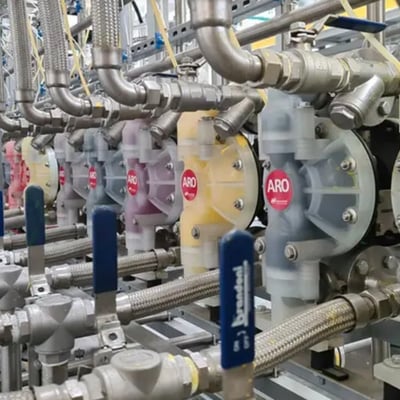 An AODD is a pneumatic positive displacement pump that uses compressed air to move two diaphragms back and forth, drawing fluid into the pump and then discharging it.
AODD pumps are used across municipal and industrial fluid-handling applications, particularly when the fluid or operating environment makes other pump types less suitable. They can handle low- to high-viscosity liquids, slurries, suspended solids, abrasive fluids, and aggressive chemicals. A variety of pump-body and diaphragm materials are also available to provide compatibility with fluids such as acids and other corrosive chemicals.
That makes AODD pumps useful for applications ranging from chemical and slurry transfer to moving paint, detergents, process chemicals, and other fluids throughout a facility. They are used across chemical and pharmaceutical manufacturing, general industrial facilities, environmental applications, and municipal water and wastewater operations.
AODD pumps can be appropriate for hazardous environments where flammable materials are present because they don’t require an electric motor at the pump.
AODD pumps are also familiar equipment for many industrial maintenance teams. Depending on the pump and issue, they can often be removed from the process and serviced using replacement components or repair kits.
Choosing the appropriate pump size, materials, and diaphragm configuration helps reduce wear, maintenance requirements, and unplanned downtime.
Metallic vs. Non-Metallic AODD Pumps
Choosing between a metallic and non-metallic AODD pump starts with the fluid being pumped. The pump’s wetted materials — the components that come into contact with the fluid — must be compatible with the chemicals, liquids, and solids in the process.
Metallic: Available in materials such as aluminum, cast iron, stainless steel, and Hastelloy. The appropriate material depends on the fluid and operating environment.
Non-Metallic: Available in materials such as polypropylene, acetal, and polyvinylidene difluoride (PVDF), with options for a range of chemical and corrosive-fluid applications.
Once you understand what the pump will be handling, other process conditions help determine the appropriate material, size, and configuration:
- Flow requirements
- Pressure
- Temperature
- Viscosity
- Suction conditions
- Connection requirements
- Installation space
- Duty cycle
IMPORTANT: Always refer to the fluid’s Safety Data Sheet (SDS) and the pump manufacturer’s chemical compatibility guidance before selecting pump materials.
ARO PRO Series Diaphragm Pumps
Those application variables are also why having a broad pump lineup matters.
The ARO PRO Series Diaphragm Pump product line from Ingersoll Rand gives industrial and OEM users a range of metallic and non-metallic AODD pump options to match different fluids and operating conditions.
The line includes pumps in multiple sizes, materials, porting options, and configurations, allowing them to accommodate specific connection layouts, installation requirements, and application needs.
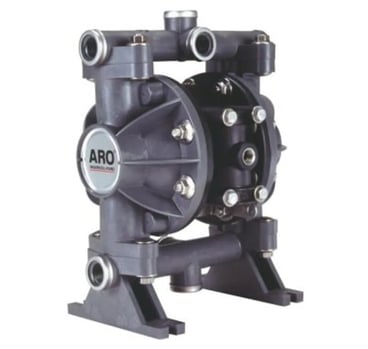 ARO PRO Series pumps can handle fluids ranging from clean, low-viscosity liquids to corrosive and abrasive, medium-viscosity fluids. They can also transfer fluids containing large particles without damage. Convoluted diaphragm options are available to extend diaphragm life and reduce maintenance requirements.
Because they are air operated, appropriately configured PRO Series pumps can also be used in potentially explosive environments.
For process applications, selecting the right pump is only part of the equation. Availability also matters. When a pump is critical to production, waiting for a replacement or repair components can extend an already costly interruption.
MCE stocks ARO PRO and Compact Series pumps and repair kits in our Power & Pumps warehouse in Jacksonville, FL.
MCE can support ARO pump applications nationwide.
A Compact AODD Option for Lower-Flow Applications
The ARO® Classic Style ½-inch Non-Metallic Diaphragm Pump is a compact AODD pump with flow rates up to 13 GPM. Its small footprint and simple design make it well suited for low-flow, intermittent-duty, and OEM equipment applications where space is limited.
When an application requires higher flow, different fluid compatibility, another connection layout, or different operating capabilities, ARO offers additional Compact and PRO Series pump options.
Learn more about ARO Compact and PRO Series Diaphragm Pumps.
ARO Pump Power for Tough Lime Slurry Application
An MCE municipal wastewater plant customer relies on pumps to move lime slurry throughout their processes. Lime slurry is a messy and demanding material, making the pump’s configuration and compatibility with the fluid an important part of the application. The pumps must safely move thick, abrasive, and sticky mixtures without clogging, scaling, or breaking down equipment. If the pumps were to go down, they would have a serious and expensive mess on their hands.
Not only did we help them select the right pump system, but we stock the pumps, genuine repair kits, and compatible components they need locally so they can get their operations back online quickly.
MCE Looks Beyond the Pump
Selecting the right AODD pump starts with understanding the process. MCE works with municipal and industrial customers nationwide to evaluate the application before recommending a pump or configuration.
That can include an in-person site visit and process evaluation to understand the fluid being pumped, operating conditions, material compatibility, installation requirements, and existing equipment. For replacement applications, MCE can also use manufacturer information, model numbers, part numbers, and specifications to help identify an appropriate replacement.
But the pump rarely operates alone. Depending on the application, the surrounding system may include valves, hose and fittings, pneumatics, filtration, instrumentation, controls, motors, drives, and other equipment. MCE can consider how those components interact with the pump and what the overall process requires.
Support continues after pump selection. We also offer:
- Application and operating-condition review
- Material compatibility review
- In-person site and process evaluation
- On-site troubleshooting
- Field and in-shop repair support
- Replacement pumps
- Genuine ARO parts and repair kits
- Support for valves, hose, fittings, pneumatics, instrumentation, and controls
Reach out and speak to a pump expert for help evaluating your application, selecting the right ARO pump and configuration, or troubleshooting an existing pump.