


Dealing with choked flow in your industrial processes, erosion to your valve plug, or maybe a constant hissing sound? You may be experiencing flashing in your control valves.
Flashing destroys equipment through severe erosion, triggers “choked flow” that restricts your plant’s capacity, and causes unpredictable, unstable system control.
Here’s how you can mitigate it.
What is Flashing?
Flashing in control valves is when a liquid flowing through a control valve experiences a pressure drop below its vapor pressure (PV) and does not recover downstream.
Inside the valve, fluid accelerates through the restricted flow area near the throttling element. As velocity increases, static pressure decreases, a phenomenon known as Bernoulli’s Principle. This occurs at the lowest-pressure point, the vena contracta. This is the narrowest effective flow area immediately downstream of the throttling restriction.
In plain terms, flashing means the liquid “boils” inside the valve due to pressure drop, and the vapor never collapses back to a liquid. This creates a high-velocity mixture of liquid and vapor flowing downstream.
In fluid systems, when local pressure drops below the liquid’s vapor pressure, bubbles form and remain in the downstream flow; that leads to increased fluid velocity and potential erosion of valve components. This erosion can gradually destroy previously smooth metal surfaces in valves.
How Flashing is Similar to Cavitation, and Different
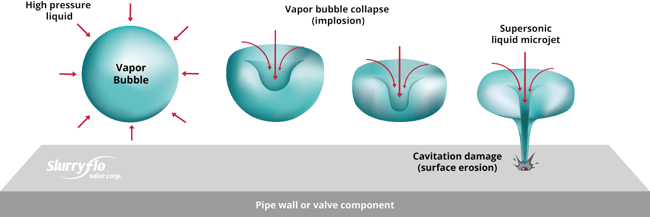
Cavitation is common in high-pressure-drop applications, particularly in liquid systems that use water or volatile chemicals used in refining, chemical processing, and power generation industries.
Flashing and cavitation both occur in piping systems and valves when the local pressure drops below the fluid’s vapor pressure and turns liquid into vapor. The difference is after bubbles form.
Here’s how cavitation and flashing are different:
Cavitation is temporary bubble formation and violent collapse when pressure recovers. The result is deep, localized pitting caused by microjets that form from collapsing bubbles.
Flashing is permanent vapor formation that continues downstream and the bubbles never collapse.
Flashing doesn’t create microjets that cause pitting and damage. But over time, it creates continuous high-velocity erosion where the vapor-liquid mixture scours internal surfaces. This thins the valve trim, decreases sealing capability, and increases contamination from eroded material.
You may notice choked flow in your industrial processes, erosion to your valve plug, or maybe a constant hissing sound.
Related: How to Overcome Cavitation in Control Valves
Why Flashing is Dangerous in Chemical and Toxic Media Applications
Flashing is like a high-speed sandblaster that causes:
- Rapid trim erosion
- Outlet piping wear
- Loss of shutoff capability
- High outlet velocity
- Difficult process control
- Continuous damage
In standard applications, flashing can cause severe damage to valves and downstream components, leading to premature equipment failure and production problems. In chemical or toxic media applications, the consequences can be even more serious.
Flashing is dangerous because a pressure drop causes part of the liquid to vaporize, creating a much higher-volume, high-velocity two-phase flow. This can cause severe erosion, vibration, and accelerated wear in valves and downstream piping.
When the process involves toxic or hazardous media, that damage can also compromise containment. Degraded valves, seals, gaskets, or piping can increase the risk of a chemical release, putting workers at risk and creating potentially serious environmental and plant safety consequences.
Severe Service Control Valves Reduce Valve Damage from Flashing
Why do standard control valves fail in flashing applications? They concentrate energy into localized high-velocity regions. The high-energy mix aggressively attacks:
- Seats
- Plugs
- Body outlets
- Piping
- Fittings
- Weld areas
While flashing cannot be completely eliminated, it can be controlled with valve design that takes into account proper geometry and materials. By controlling velocity, minimizing erosion, and protecting containment with the right valves, you can dramatically improve process reliability.
Severe Service Valves Designed to Control Flashing
Valve manufacturers use one or more designs to protect valves from flashing and cavitation:
- Resistance: Using hardened materials that are less vulnerable to erosion.
- Isolation: Designing flow paths that minimize impingement of flashing or cavitation on valve surfaces.
- Elimination: Engineering pressure drops to spread the drop across multiple locations through drilled hole cages, tortuous paths, or other trim designs.
One of our preferred manufacturing partners, Flowserve, addresses fluid flashing with specialized severe-service control valves. These valves feature hardened, erosion-resistant ceramic trims that direct flashing energy away from critical components, preventing damage to vulnerable surfaces.
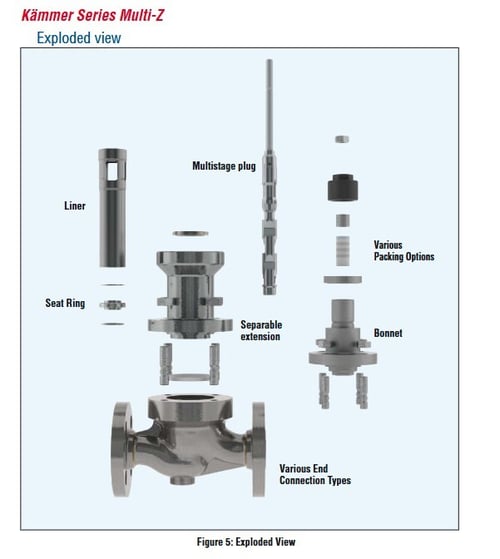 Severe-service trim offers the following benefits:
- Improved control accuracy even under unstable conditions
- Reduced wear on internal surfaces exposed to high velocity or phase change
- Longer operational life before maintenance is required
We partner with Flowserve and other leading brands because they approach valve design as integrated systems that work together, including valve bodies, trims, sealing components, and actuators.
By taking a system-based approach, mechanical forces are balanced, flow behavior is predictable across operating ranges, and actuation response match internal valve dynamics.
Two examples of control valves designed to minimize the impact of flashing include:
Flowserve Valtek® Survivor: Specifically designed to manage high-velocity flashing mixtures and erosive particulates, extending service life in demanding environments. The unique design of the Survivor directs flashing energy away from critical equipment. Unique packing configurations solve difficult sealing problems associated with solids entraining the process fluids. Learn more.
Flowserve Kammer Multi-Z: Multi-Z Severe Service control valve handles high-pressure drop applications where entrained solids and cavitation are a problem. Designed for dirty service applications with excessive noise, cavitation, erosion, or high-pressure drops. Learn more.
Flowserve’s engineered valve systems are designed as integrated systems, delivering reliability, precision, and durability in demanding environments.
Manage Process System Flashing Better with MCE
MCE combines application-level diagnostics with targeted severe-service valve solutions. We’ll evaluate your system conditions to identify underlying issues before applying the right strategy to solve them. Through material evaluation, proper valve and trim selection, retrofit support, and system-level optimization, we can help you reduce erosion, extend your equipment life, and maintain reliable process performance in your demanding flow applications.
Our team of factory-certified technicians provide in-house and in-field support to keep your processes safe, reliable, and efficient. Our instrumentation and calibration services cover the lifecycle of your critical assets, including valves, actuators, and sensors.
We offer comprehensive evaluation, repair, and replacement services on your industrial flow equipment, including:
- Supporting technical issues onsite or remotely via phone or video call
- Complete valve repair and rebuild program capability
- Hydro- and leak testing
- Advanced diagnostic positioners and accessories in stock and ready to ship
- Seven valve repair locations throughout the U.S.