


In the oil and gas industry, process stability requires sophisticated control systems, automation platforms, and advanced instrumentation. These are all critical, but one of the most important factors in maintaining stable operations is often overlooked.
Valve selection.
Valves are the final control element. Valves maintain desired operating conditions despite changes in demand, pressure fluctuations, temperature variations, or process disturbances.
A valve that is improperly selected or sized leads to flow instability, excessive wear and maintenance, energy inefficiency, and safety risks.
Related: Emergency Valve Repair Planning: Minimizing Downtime for Oil and Gas Operations
How Valves Matter Across Oil & Gas Sectors
 Upstream (Finding and extracting oil and gas)
Exploration and production (E&P) valves control, direct and regulate the immense pressure and flow of hydrocarbons, ensure operational efficiency, protect billions of dollars of equipment, and prevent catastrophic environmental damage.
Midstream (Transporting and storing hydrocarbons)
Processing and transportation valves direct, isolate, and regulate the flow and pressure of crude oil and natural gas across thousands of miles of pipeline. A single failure here can result in unplanned downtime, catastrophic accidents, environmental impacts, and severe economic losses.
Downstream (Refining and distributing end products)
Refining and distribution valves ensure precise process control, protect critical equipment from overpressure, control flow direction and backflow prevention, and enable rapid system isolation for safety.
Severe Service Realities in Oil & Gas
Oil and gas environments are rarely forgiving. Many applications involve extreme temperatures, fire hazards, high pressure differentials, abrasive media, corrosive fluids, and rapidly changing conditions.
Common challenges include:
- High pressure drops
- High temperatures
- Cavitation
- Flashing
- Erosion
- Corrosion
- Exposure to hydrogen sulfide
For that reason, standard valves often degrade rapidly and when internal components wear out, control accuracy diminishes, leaks increase, and process stability suffers.
Process Stability Begins with Valve Performance
Across upstream, midstream, and downstream operations, process stability depends on how well valves maintain precise control over three variables:
Pressure Control
Pressure fluctuations can have a significant impact on equipment performance, production rates, and safety. Valves play an important role in maintaining stable pressure conditions by regulating flow and responding to changing process demands.
With the wrong valves, the system may struggle to manage pressure drops and lead to unstable operating conditions, equipment stress, and diminished process reliability.
Flow Regulation
Consistent flow is essential for maintaining throughput, flow accuracy and responsiveness, and achieving production targets. Valves that are improperly selected often create control challenges that persist through the entire process.
Temperature Management
Temperature control valves regulate steam and cooling water flow to maintain stable process temperatures in oil and gas operations. Precise control ensures efficient heat transfer, consistent product quality, and reliable equipment performance. Valves that cannot respond accurately to changing process conditions may allow temperatures to drift outside their target range, reducing efficiency and increasing wear on critical assets.
How to Select the Best Valves for the Oil and Gas Industry
MCE trusts Flowserve for valve solutions ranging from general purpose isolation to severe service control, whether it’s upstream extraction, midstream pipelines, or downstream refining. Learn more about Flowserve valve solutions.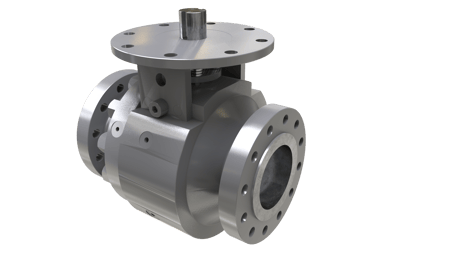
- Ball & Severe Service: Quarter-turn ball valves, including severe-service trunnion and floating options, often featuring custom trims for demanding pressure and flow requirements. MOGAS Severe Service Valves from Flowserve are engineered for high-cycling and severe-wear environments like pressure swing adsorption (PSA) and extreme temperature applications.
- Gate Valves: Includes slab gate, compact expanding gate, and split wedge configurations designed for on/off isolation and tight shutoff in high-pressure liquid and gas pipelines. These valves are generally not recommended for modulating flow control applications.
- Globe Valves: Known for high-pressure, high-temperature tolerance. Globe valves provide excellent control in modulating applications. Flowserve offers T-pattern, Y-pattern, and split wedge globe valves engineered to minimize destructive turbulence.
- Plug Valves: Designed for reliable on/off isolation in toxic, corrosive, and high-pressure applications. Pressure-balanced, low-torque designs make them well suited for demanding service, although they are used less frequently in oil and gas.
- Control Valves: Modulating valves designed to automatically maintain process variables such as flow, pressure, temperature, or level at a desired setpoint. Control valves are available in linear designs, such as globe valves, as well as rotary designs, including ball and butterfly valves, depending on the application.
- Isolation Valves: On/off valves designed to start or stop the flow of liquids or gases. Depending on the application, isolation valves may use gate, globe, ball, plug, or butterfly valve designs to provide reliable shutoff.
Related: How to Overcome Cavitation in Control Valves
The Importance of Matching Valve Actuators to the Application
Valve selection is rarely just about the valve body and trim. A valve actuator is a mechanical, pneumatic, or electric device that provides the power and motion to open, close, or throttle a valve. These are critical for remote and automated pipeline flow control, emergency shutdowns, and managing extreme pressures.
In many applications, an actuator determines:
- Shutoff capability of a valve
- Response speed
- Fail-safe position
- Control accuracy for modulating valves
- Available torque/thrust under operating conditions
- Power source requirements
- Reliability and maintenance needs
- Integration with automation and safety systems
Matching the right actuator to your valve is vital to ensure safety, process efficiency, and equipment longevity. An improperly matched actuator can cause reduced control accuracy, slow response to process changes, increased mechanical wear, premature equipment failure.
MCE Solves the Oil & Gas Industry’s Most Challenging Problems
MCE provides products, services, and technical support from top-rated oil and gas valve manufacturers to help oil and gas companies minimize downtime, improve operations, and address workforce gaps.
MCE also offers certified precision valve repair, replacement, and testing services for safety relief valves as part of a broader strategy to help your operation minimize unplanned downtime. Our CCST Level II certified technicians can assess valve performance, identify issues early, and provide fast turnaround on necessary repairs, all while ensuring compliance with API and ASME standards.
We support oil and gas specifications across all oil and gas sectors, with solutions that include:
- API-6D Valves
- API Tank Vessel Codes
- NACE Valves
- FM Class 1 Div 1 Explosion Proof Instrumentation
- SIL Rated Instrumentation
- Solutions for Safe Operation of Hydrofluoric Acid
From knowledgeable consulting and technicians to readily available products and services, MCE’s team will keep your facility safe, productive, and regulation ready.
Talk to an MCE valve expert today to schedule a consultation.