

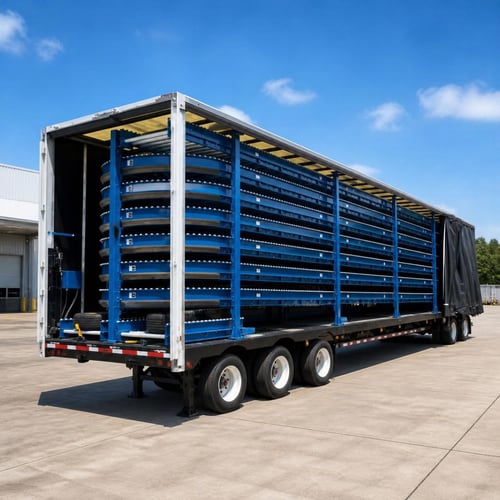
Automated tire-and-wheel conveyor trailers reduce manual handling, maintain sequence from the tire-and-wheel facility through delivery, and keep assemblies moving to the line at the required production rate.
But getting those benefits requires designing the system around the application. Production volume, tire-and-wheel sizes, travel requirements, and the plant itself can all affect what the final system looks like.
We work through those operating requirements with the manufacturer and other partners in the tire-and-wheel program. The process starts by answering five questions about how the system will need to operate.
 1. How fast does production need to run?
The expected job rate gives a starting point for determining how much tire-and-wheel capacity needs to move through the system. From there, we consider trailer capacity and how many trailers need to be circulating to support production.
At any given time, one trailer may be loading while another is traveling to the plant, another is unloading, and another is making the return trip. The fleet needs enough capacity across that cycle to keep pace with the assembly line.
Properly sizing the system helps manufacturers maintain the required flow without paying for unnecessary capacity or discovering later that a fleet can’t keep pace.
In one case, our initial calculations indicated that a manufacturer would need more than the two trailers it planned to purchase. As production requirements developed, the manufacturer ultimately added two more.
2. What tire-and-wheel assemblies will the system handle?
Size and weight are important considerations and can have a cascading effect on the system. Larger assemblies take up more physical space, which can reduce the number that fit within a trailer. Additional weight also must be considered when trailers travel on public roads.
Those considerations have become more important as tire-and-wheel assemblies have grown larger, particularly for trucks and other larger vehicles. We look at the full range of assemblies the trailer will need to carry rather than sizing the system around a single tire size or configuration.
That information helps determine a configuration that can accommodate the manufacturer’s product mix while making effective use of available trailer capacity.
3. What does the complete delivery cycle look like?
The number of assemblies a trailer can carry is only part of the capacity picture. We also look at how the trailers will operate between the tire-and-wheel facility and the assembly plant:
- How far apart are the facilities?
- How long does loading and unloading take?
- How quickly does an empty trailer return?
- How many trailers need to be in circulation at once?
Two plants running at the same production rate could require different trailer fleets. If one tire-and-wheel facility is farther from the assembly plant, each trailer spends more time in transit before it becomes available for the next cycle.
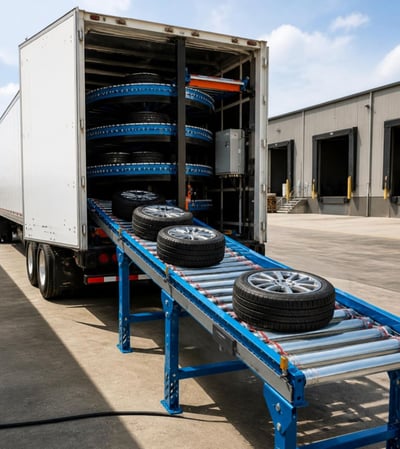
The delivery process also affects how assemblies are handled along the way. An automated system can maintain sequence through transport and unload directly into the plant’s material-handling system, reducing manual transfers between the supplier and the assembly line.
Looking at the complete cycle helps us determine the capacity needed to maintain a consistent supply of assemblies to production.
4. How will the tire-and-wheel conveyor system fit the existing plant?
We never design a trailer in isolation. Our team looks at how it will dock, connect and operate within the manufacturer's existing environment.
Details like these are much easier to accommodate during system design than after equipment arrives on site. That makes a review of the dock area and surrounding infrastructure an important part of the process, especially when the system is being added to a facility rather than designed into a new one.
The same applies to the equipment on either side of the trailer. The trailer must work with the loading system at the tire-and-wheel facility and the receiving system at the assembly plant, so we consider those interfaces as part of the application rather than treating the trailer as a standalone piece of equipment.
For example:
- One facility's pavement slope required us to account for how the trailer would sit at the dock.
- An existing structural beam at another plant affected the loading/unloading arrangement.
- Safety fencing at another application influenced where drivers could connect the trailer.
Those aren't unusual exceptions, but it’s important to evaluate the actual environment and work with the customer to determine how the system needs to fit within it.
Addressing these conditions during design reduces installation and commissioning problems and creates a smoother interface between transportation and the plant's existing material-handling system.
 5. What might change over the life of the tire-and-wheel equipment?
Automated trailers can remain in operation for decades. During that time, production volumes, vehicle programs, and tire sizes can all change.
That doesn't mean designing today's system around every vehicle or tire size a manufacturer might produce someday. But if a new program is already planned, production volumes are expected to change, or larger assemblies are on the roadmap, those requirements are worth discussing before the initial design is finalized.
We have worked with customers to modify existing trailers for new vehicle programs rather than replace equipment that is still mechanically sound. Whether that's possible depends on how significantly the new requirements differ from the original application.
Considering known changes early can help manufacturers determine where it makes sense to build flexibility into the initial design and potentially extend the useful life of the equipment across multiple programs.
Start With the Application
The right configuration depends on more than how many assemblies need to fit in a trailer. The process starts with understanding how the system needs to operate within the manufacturer’s production and delivery environment.
Taking that approach early helps manufacturers avoid discovering capacity or integration issues later and gives them a system designed to reduce handling, preserve sequence, and keep tire-and-wheel assemblies moving at the rate production requires.
Ultimation, an MCE company, is a turnkey vendor. We help our customers identify the right solution for their operation. This includes:
- Dock geometry that may need a leveling ramp
- Safety Restraint Systems
- Electrical panel to control the trailer operation
- In-plant conveyors to send or receive the tire/wheel assemblies
- In-plant tire/wheel buffer system
- Spare parts supplies to support the trailer lifecycle
Learn more about automated trailers for loading and unloading tire-and-wheel assemblies.