
Plant automation projects rarely fail because the technology doesn’t work. More often than not, they struggle because the right conversations didn’t happen early enough. Too many automation efforts begin with a solution already decided, rather than a broader discussion about the processes, constraints, and long-term goals.
-
“We need a robot.”
-
“We need vision.”
-
“We need to automate this station.”
By the time automation partners are brought into the conversation, budgets are fixed, layouts are locked in, and timelines are tight. At that point, even the best technology couldn’t meet those needs effectively.
That’s why the most successful automation projects don’t start on the factory floor; they start at the front end with early collaboration. It’s time to rethink early collaboration and cross-disciplinary input for the long-term value of your automation projects.
The Issue: Factory Automation is Often Treated as a Late-Stage Purchase
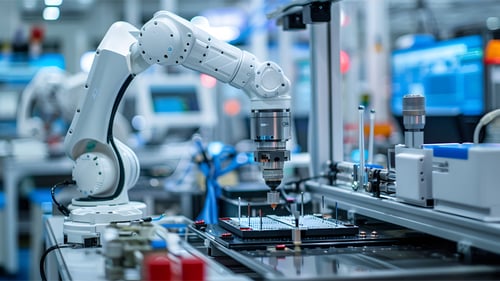 We’ve seen a common pattern across manufacturing environments when deciding on automated solutions.
-
A fixed idea (“We need a robot here”)
-
A fixed budget
-
A fixed timeline
When automation is framed this way, flexibility disappears fast. Design decisions get constrained before anyone has a chance to step back and consider if the original assumption was the right one. There’s also a natural tendency to imagine automation as something dramatic or expensive. (Think: Robots’ arms swinging overhead or zipping along the facility floor at breakneck speeds.)
That mental picture can push teams to over-engineer solutions that solve one problem while creating another. Or cause them to abandon an idea because it feels too expensive or disruptive.
In reality, automation exists on a spectrum. But when collaboration starts too late, teams often leap too far along that spectrum, skipping past simpler, lower-risk options that make more sense.
Then, they’re left with:
-
Over-specified systems that exceed actual needs
-
Equipment that’s underutilized because it doesn’t fit the process
-
Missed opportunities for data capture and integration
-
Automation that solves one bottleneck while creating another
-
Higher maintenance and training costs than expected
-
Material waste or reworks
These issues usually surface after installation, when changes are most expensive.
Check out MCE's Library of Automation Resources
What Early Automation Collaboration Actually Looks Like
Automation shouldn’t be a single decision. It should be a series of decisions that involve all affected departments. After all, it will likely include changes and improvements to material flow, assembly tools, safety systems, and people in those departments.
Early engagement with an automation provider like MCE allows engineers and maintenance teams space to explore all the options available, to see what’s possible and what makes sense for production needs.
Engagement doesn’t mean your automation partner shows up with a sales pitch, either. They should be your design and brainstorming partner to:
-
Ask why before defining how
-
Review the current processes onsite
-
Test ideas before scope is finalized
-
Bring application engineers and control specialists into early conversations
-
Use demos, prior applications, and layout concepts to shape thinking
-
Consider partial automation instead of full system replacement
Compared with late-stage consultation, early collaboration enables multiple options, including different layouts, levels of automation, or phased approaches that allow manufacturers to grow into automation over time.
This flexibility is critical, especially for manufacturers who want to automate but don’t want to disrupt production or take on unnecessary risks.
With early collaboration, you have more opportunities to test before going live. This allows you the ability to verify and validate the system’s performance before production goes back online. During this time, it’s vital to train people on how to use, maintain, and support automated lines.
Without it, you risk excessive material scrap, poor performance, or limited communication between systems.
Related: 7 Steps to Modernize Your Plant Safety
Collaborative Real-World Outcomes: Factory Automation in Action
Bringing in MCE’s Engineered Solutions Group (ESG) into the discussion early can help manufacturers identify and implement cost-effective automation solutions, avoid overcomplicating projects, and achieve better results long-term.
Here are a couple of examples:
Automation in Medical Device Manufacturing
The Problem
A medical device manufacturer was facing rising demand and concerns about falling behind on monthly production targets. Leadership assumed the next step would require expanding the facility or adding shifts, both expensive and disruptive.
The Issues
-
Previous projects brought automation partners in late, not focusing on overall throughput
-
Existing material flow relied heavily on carts and racks
-
Bottlenecks were treated as isolated problems rather than system-level issues
-
Automation discussions leaned toward robots instead of evaluating production flow
The Solution
The customer engaged with MCE’s Engineered Solutions Group early, before any layout changes or equipment decisions were locked in. Instead of leaping right to robotics as a solution, the ESG team evaluated:
-
End-to-end material flow
-
Opportunities to replace carts and racks with conveyor systems
-
Where automation could smooth transitions between processes rather than replace operators
The Impact
By addressing production flow first and selectively applying automation, the team redesigned material flow without increasing the building’s footprint.
-
Monthly production output increased significantly
-
Minimal production disruption during implementation
-
Improved consistency and predictability across the line
-
No extra shifts were needed
The manufacturer increased production from 500 to 1,000 units per month through automation, with plans to reach 12,000 units monthly.
Automation in Automotive Manufacturing
The Problem
An automotive manufacturer was struggling with frequent product changeovers in an assembly operation that relied on traditional bowl feeders. Each part variation required mechanical adjustments or new tooling, leading to downtime, added cost, and scheduling changes.
The Issues
-
Mechanical bowl feeders were optimized for a single part geometry
-
Changeovers required physical retooling and skilled labor
-
Downtime increased with higher product mix
-
Feeding decisions were treated as isolated components, not part of the overall automation strategy
The Solution
By engaging MCE Engineered Solutions Group early, before committing to another replacement feeder design, the team took a step back to evaluate the problem. Instead of asking about a different feeder for each part variation, they considered how to make feeding components more flexible to meet all production demands.
Together, they landed on a flexible feeding solution, the Asyril Flexible Feeder:
-
A flexible feeding system capable of handling multiple part variations
-
Software-based changeovers instead of mechanical adjustments
-
Integrated with Ai vision and robots to manage to part variations & differences
The Impact
By involving MCE early, the customer avoided another rigid feeding solution and implemented an automated system designed for long-term flexibility.
-
Significantly reduced changeover time
-
Lower initial & long-term tooling and maintenance costs
-
Improved responsiveness to product mix changes
-
Increased uptime and more predictable production scheduling
Related: Automation for Modern Manufacturing
In both cases, early collaboration gave engineers and maintenance teams the space to explore these options without feeling pressured to make an expensive and overly complex decision.
MCE’s Cross-Divisional Collaboration Makes Automation Make Sense
Automation in a manufacturing facility rarely impacts just one discipline.
Robotic decisions affect conveyance. Vision systems affect controls and safety. Data connectivity affects IT. And maintenance requirements affect activities and budgets long-term.
For automation to make sense, these interdependencies need to be visible and acknowledged instead of attempting to solve problems in isolation.
MCE’s Engineered Solutions Group leverages its companies and automation manufacturing partners to bring together expertise in:
-
Robotics and motion
-
Conveyors and material handling
-
Vision and sensing
-
Safety sensing and barrier protection (fencing / gates)
-
PLCs, HMIs, and industrial controls
-
Vendor-managed inventory
From dock to door, we’ve got you covered.
Related: From Receiving to Shipping: Full-Scale Automation in Manufacturing
Full integration like this gets key players involved early, before solutions are set in stone. As a result, there is less time spent identifying issues, fewer dollars spent on ineffective or incompatible solutions from different providers, and more successful integration throughout solution components.
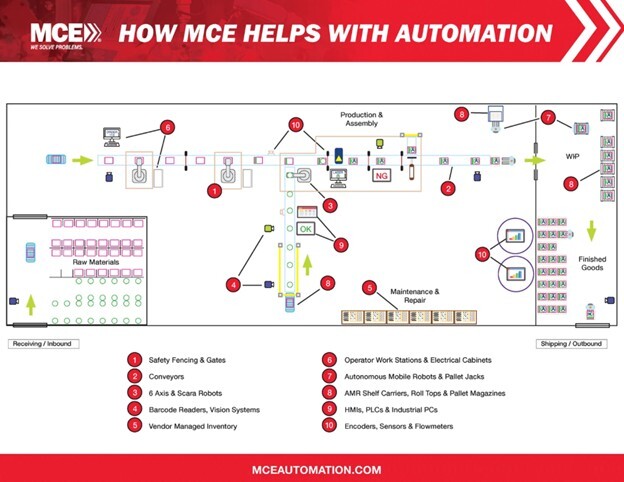
MCE’s ESG consulting team is embedded throughout all phases and lifecycles of automation projects.
Your automation partner should be your advocate, not just a seller. This means front-loading all the information a customer needs to know about an automation project to protect the customer’s budget and performance goals. This should include costs, limitations, training needs, communication requirements, and safety and production goals.
Contact us today to explore how we can engineer modern automated solutions tailored to your operation.
Industrial Automated Solutions Don’t Have to Be Scary or Expensive
Automation doesn’t have to be all or nothing. Many successful automation projects start small.
-
A few thousand dollars, not millions
-
A single station upgrade, not a full line
-
An initial phase that proves value before expanding
The most effective automation fits your process, supports your people, and grows with your business. The difference happens when you work with an automation partner early in the process. Start the conversation today with an MCE automation expert, even if it’s a rough idea or a “napkin sketch.”
Give us a call today to discuss your automation needs.