

Nitrogen is essential in food and beverage packaging, chemical blanketing, laser cutting, plastics, electronics, oil and gas, and other industrial processes. Many facilities buy nitrogen through bulk liquid supply, but that model can create ongoing costs tied to delivery, tank rental, surcharges, evaporation loss, and long-term supplier contracts.
On-site nitrogen generation gives facilities another option: produce nitrogen from compressed air at the purity level the application actually requires. For many operations, that can reduce nitrogen costs, improve supply reliability, and eliminate some of the hidden expenses that come with bulk liquid nitrogen.
This article compares bulk nitrogen supply and on-site nitrogen generation so you can evaluate which approach makes the most sense for your facility.
Common Industrial Uses for Nitrogen
Nitrogen is used across many industrial processes where an inert gas helps protect products, reduce oxidation, improve safety, or support production quality. Common examples include:
- Food and beverage: Modified atmosphere packaging to help extend shelf life.
- Chemical processing: Tank blanketing and inerting.
- Laser cutting and metal fabrication: Oxidation prevention during cutting and forming.
- Plastics: Gas-assist injection molding and process protection.
- Oil, gas, and mining: Combustion risk reduction and inerting.
- Electronics: Dross reduction and process atmosphere control.
For many facilities, the default option has been bulk liquid nitrogen supply. That can work well in some applications, but the quoted CCF rate does not always show the full cost. Tank rental, delivery charges, environmental surcharges, telemetry fees, inspections, taxes, and evaporation loss can all increase the true cost of delivered nitrogen.
What Is Bulk Liquid Nitrogen Supply?
Bulk liquid nitrogen supply is a delivery-based nitrogen model where nitrogen is produced off site, transported to a facility by truck, and stored in a cryogenic bulk tank until it is needed for the process.
For many facilities, this is the traditional way to buy nitrogen. It can be a good fit for low, inconsistent, or highly specific nitrogen needs, but the total cost often includes more than the quoted usage rate. Tank rental, delivery charges, surcharges, inspections, telemetry fees, contract terms, and evaporation loss can all affect the true delivered cost.
How Bulk Liquid Nitrogen Is Produced
Bulk liquid nitrogen is typically produced through cryogenic separation, a process that separates argon, oxygen, and nitrogen by cooling air until each component reaches its boiling point. In this process, argon, oxygen, and nitrogen are separated as each component reaches its boiling point temperature:
- Argon: 297° F
- Oxygen: 303° F
- Nitrogen: 320° F
A phase change occurs from the gas phase to the liquid phase. Fractional distillation is then used to separate and collect argon, oxygen, and nitrogen.
What Costs Are Included with Bulk Nitrogen?
Once collected, nitrogen is an incredible asset that can be packaged and sold for industrial use. Nitrogen is priced in 100 cubic foot increments (CCF), which means one gallon of liquid nitrogen is 93.11 cubic feet of nitrogen gas. The rates you will pay for this nitrogen vary not only by the vendor, but by the region, and generally ranges from $0.40 to $1.00 or more per CCF.
The CCF rate is only one part of the total delivered cost. Depending on the supplier agreement, facilities may also pay for:
- Tank Rental: Often $2,000 or more per month.
- Delivery Charges: As much or more than $100 per delivery.
- Environmental Surcharges: $35 to $50 per delivery.
- Telemetry Charge: To measure usage $75 to $100 per month.
- Taxes & tank inspection fees.
Together, those charges can raise the effective cost to $1.15 to $2.00 or more per CCF. Facilities may also lose 10% to 15% of stored nitrogen through evaporation and venting as liquid nitrogen warms.
In other words, part of the nitrogen you pay for may never reach your process.
Bulk Nitrogen Storage and Contract Considerations
Bulk nitrogen can also require facility preparation and ongoing storage planning. Beyond usage fees, facilities may need to account for fixed and variable costs tied to storage, safety, and supplier access.
Bulk liquid nitrogen contracts often include terms that can make switching suppliers or changing supply models difficult. Some agreements include evergreen terms or long cancellation windows, such as 12 months’ notice, which can be easy to overlook until a facility wants to make a change.
Key needs for onsite bulk nitrogen storage:
- A concrete pad with fencing and signage for onsite storage.
- Safety measures, proper training of personnel, and safety gear.
- Ventilation and air monitoring.
- Regular refilling space and time consumption.
- Emergency preparedness in the case of leaks or spills with containment apparatus.
- Insurance costs for protection against accidents or liabilities.
- Irregular delivery and replenishment where you are at the mercy of the supplier.
Bulk Nitrogen vs On-Site Nitrogen Generation
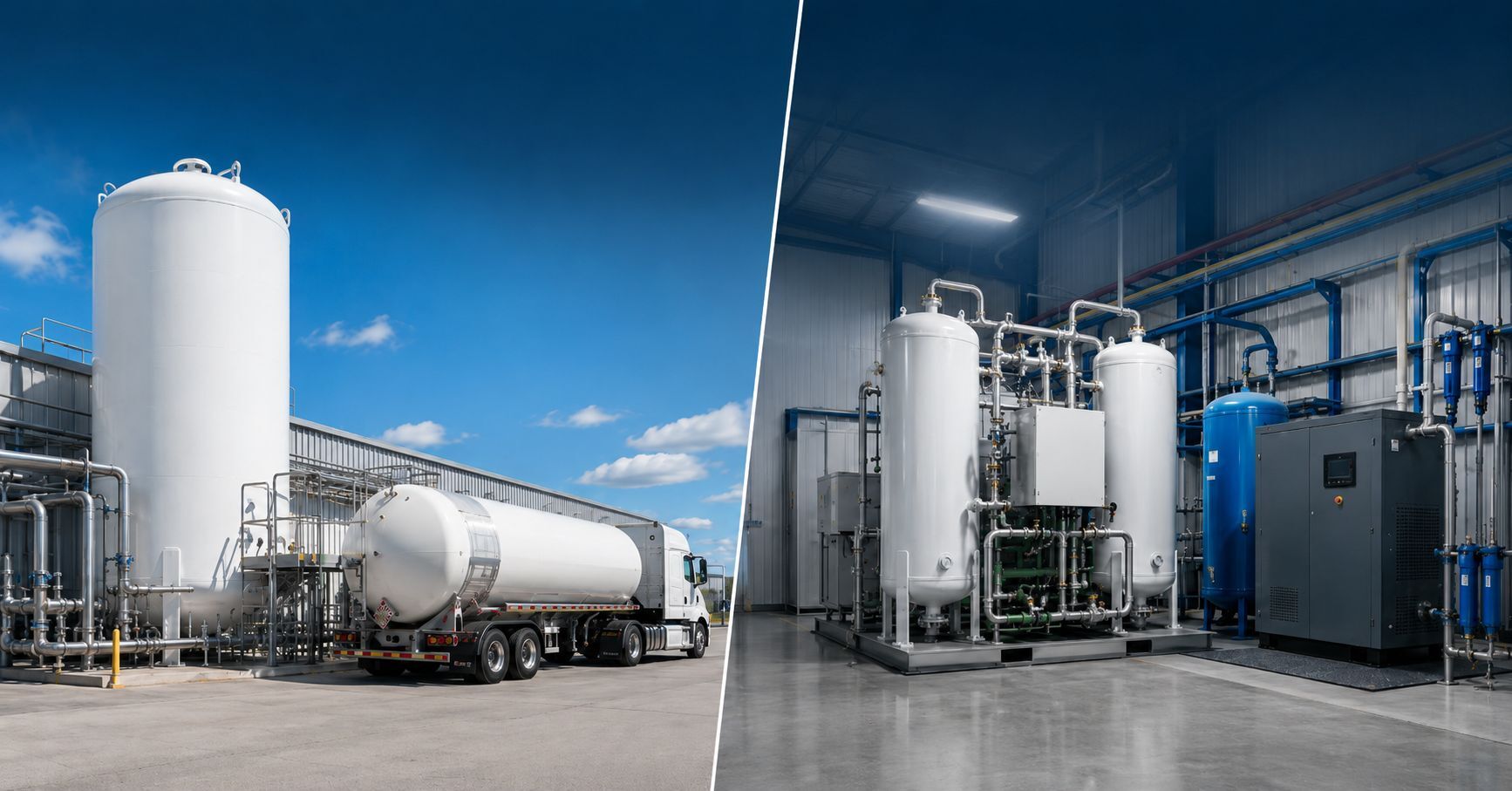
Bulk liquid nitrogen and on-site nitrogen generation can both be valid supply models. The better choice depends on how much nitrogen your facility uses, the purity your process requires, your available compressed air capacity, storage requirements, delivery reliability, and the true delivered cost of your current nitrogen supply.
For many facilities, the decision comes down to a practical question: does it make more sense to keep buying nitrogen from a supplier, or produce nitrogen on site at the purity level your application actually needs?
| Factor | Bulk Liquid Nitrogen | On-Site Nitrogen Generation |
|---|---|---|
| Supply model | Nitrogen is produced off site, delivered by truck, and stored in a bulk tank. | Nitrogen is produced at your facility from compressed air. |
| Cost structure | Costs may include CCF rate, tank rental, delivery fees, surcharges, telemetry, inspections, taxes, and evaporation loss. | Costs are tied to equipment investment, compressed air energy, filtration, and routine maintenance. |
| Purity | Often supplied at very high purity, whether or not the application requires it. | Can be generated at the purity level required by the application. |
| Storage requirements | Requires a storage tank, pad, fencing, signage, safety planning, and supplier access. | Requires space for the generator, air treatment equipment, and compressed air support. |
| Reliability | Dependent on supplier availability, delivery schedules, contract terms, and storage levels. | Gives the facility more control over day-to-day nitrogen availability. |
| Scalability | Changes may depend on supplier agreement, tank capacity, and delivery frequency. | Can often be sized or expanded around flow, pressure, and purity requirements. |
| Best fit | Lower or inconsistent nitrogen use, temporary needs, or applications with very specific supply requirements. | Steady nitrogen demand, high usage, cost reduction goals, and facilities that want more supply control. |
In general, bulk nitrogen may be simpler for facilities with low or occasional nitrogen use. On-site nitrogen generation becomes more attractive when nitrogen is used consistently, delivery-related costs are rising, storage is a challenge, or the facility is paying for a higher purity level than the process actually requires.
That is where pressure swing adsorption, or PSA, becomes useful. PSA nitrogen generation allows facilities to produce nitrogen on demand from compressed air, often at a lower long-term operating cost than delivered bulk liquid nitrogen.
What Is On-Site Nitrogen Generation?
On-site nitrogen generation uses compressed air to produce nitrogen gas at the facility instead of relying on bulk liquid deliveries. Pressure swing adsorption, or PSA, separates nitrogen from oxygen and other gases so the facility can generate nitrogen at the purity level its process requires.
For facilities with steady nitrogen demand, PSA nitrogen generation can significantly reduce operating costs compared with bulk liquid nitrogen, especially when delivery charges, tank rental, surcharges, evaporation loss, and purity requirements are included in the comparison.
How Pressure Swing Adsorption Nitrogen Generation Works
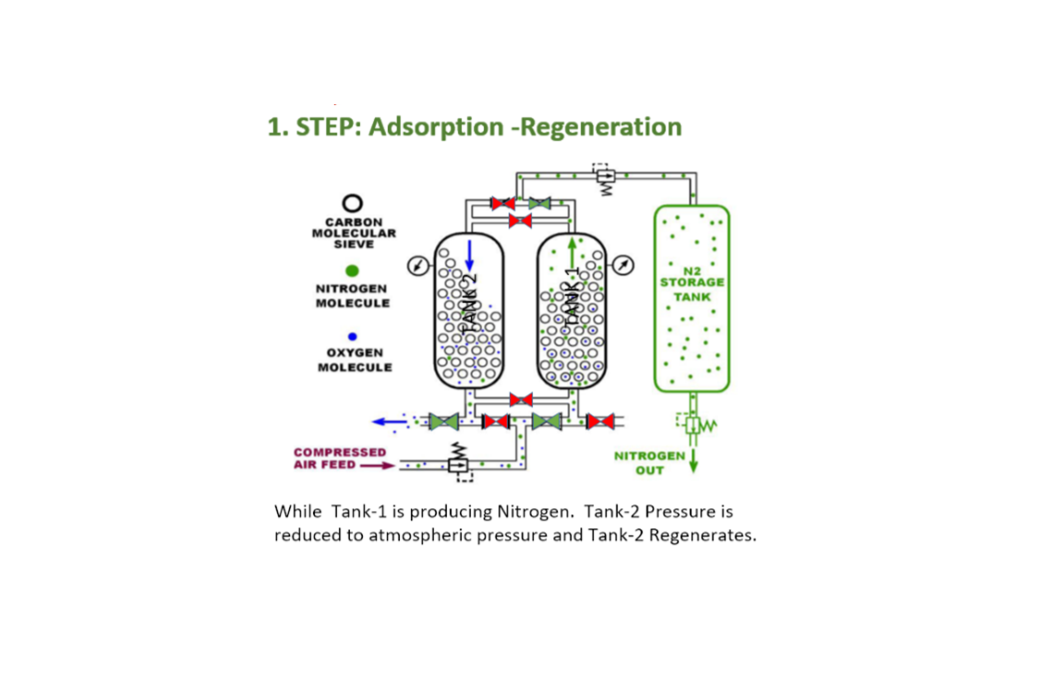
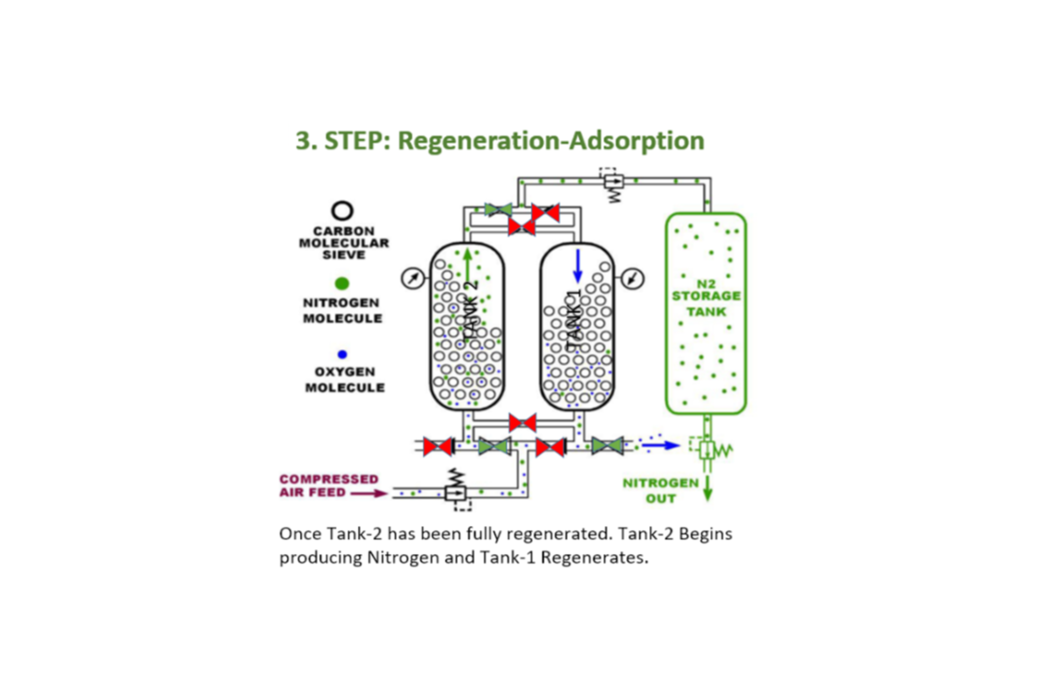
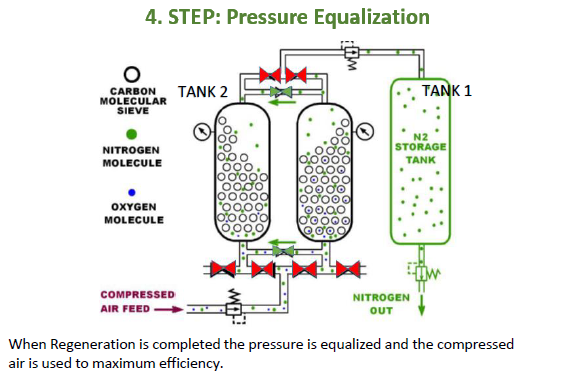
In simple terms, PSA uses compressed air and carbon molecular sieve material to separate nitrogen from oxygen. Oxygen molecules are adsorbed by the sieve material under pressure, while nitrogen passes through to the process. The system alternates between two towers so one tower produces nitrogen while the other regenerates.
Here is the technical sequence of how the process works:
PSA is a separation technology that uses compressed air to separate oxygen, argon, and other trace elements to produce nitrogen from 95% to 99.999% purity. The nitrogen is separated in a gaseous state and stays in a gaseous state.
A nitrogen generator consisting of twin towers is fed compressed air through an activated Carbon mist eliminating filter, which purifies the air before it enters the pressure tanks. Each tower is filled with Carbon Molecular Sieve Media (CMS) that is porous and adsorbs the oxygen molecule when pressurized and will not accept the nitrogen molecule which is slightly larger.
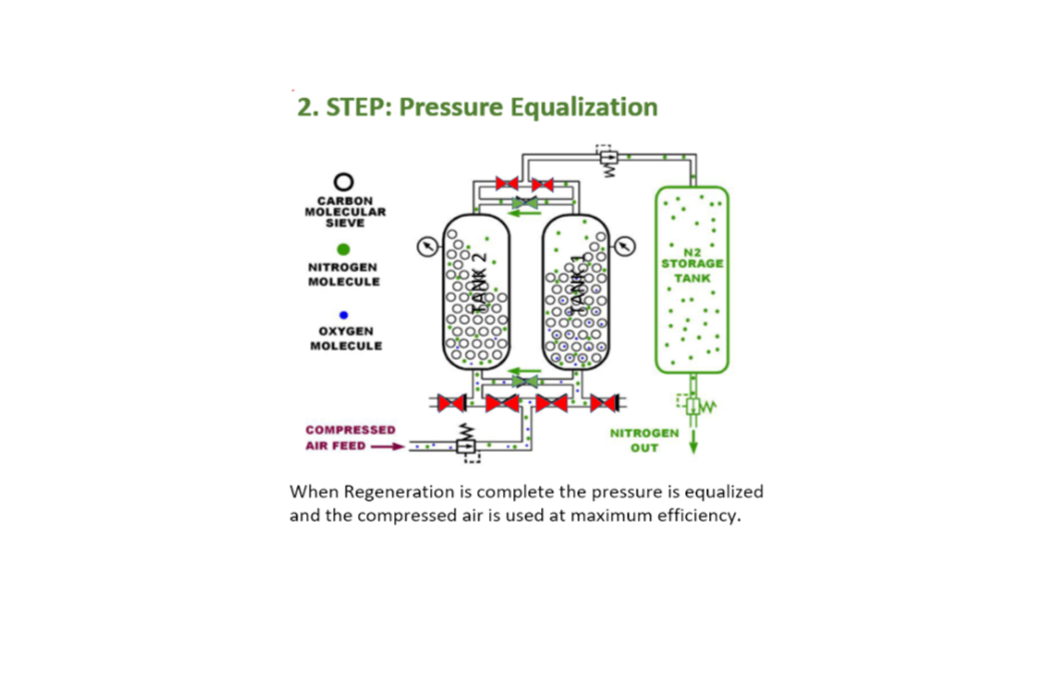
The compressed air enters tower 1 and the tower begins to pressurize, and the oxygen molecule is adsorbed by the CMS. During this period under pressure, the oxygen molecule is held in the media and the nitrogen molecule is released to the process. All while remaining in a gaseous state. After a programmed time, the first tower is rapidly de-pressurized allowing the oxygen to be released from the CMS media and vented into the air. While Tower 1 is de-pressurizing, Tower 2 is building pressure undergoing the same process of creating nitrogen.
This switching repeats every 60 seconds providing a constant monitored flow of nitrogen to the process in the facility.
The CMS material is porous, however, the oxygen molecule under pressure adheres within the pore of the CMS The nitrogen molecule will not adhere to the CMS. During the de-pressurization of the tower the tower is automatically closed to the nitrogen feed process and the oxygen is desorbed from the CMS.
Note: Electronic monitoring allows the switching of the towers and sequentially closes and opens tower valves so that oxygen is not released into the nitrogen feed process downstream. A flow meter and oxygen analyzer closely monitor the nitrogen after the process.
Why Nitrogen Purity Affects Cost
Nitrogen purity has a direct impact on operating cost. Higher purity usually requires more compressed air, which means more compressor energy. If a process only needs 95% to 99% nitrogen, generating or buying 99.999% purity may add unnecessary cost.
Purity is also sometimes confused with cleanliness or “medical grade.” For most industrial applications, the key question is not whether nitrogen is “better” at the highest possible purity. The key question is what purity the application actually requires.
Very simply, 99.999% nitrogen purity is 10 parts per million (PPM) oxygen—the highest purity level available. Bulk liquid nitrogen is by default (10PPM) oxygen. You have no choice but to use the highest purity nitrogen and of course pay for that purity too. However, only very few applications require that level of purity.
As you can see on the chart below, the higher the purity the greater the requirement for compressed air volume:
| Nitrogen Purity | A/N Ratio |
|---|---|
| 95% | 2 |
| 97% | 2.3 |
| 98% | 2.4 |
| 99% | 2.7 |
| 99.50% | 3 |
| 99.90% | 4 |
| 99.95% | 4.1 |
| 99.99% | 5.2 |
| 99.999% | 8.4 |
Having the nitrogen purity (relative to oxygen content) correct will determine energy savings. When generating nitrogen in-house, compressed air is most of the cost of that nitrogen generation. The higher the purity, the harder the compressor must work, the more electricity is used to operate the compressor.
As seen below, the top ten uses for nitrogen in the United States and the normal nitrogen purities that they require, most operations can operate at 95% purity, creating a cost savings opportunity for you.
| Process | N2 Purity Range | Compressed Air | Nitrogen |
|---|---|---|---|
| Food & Beverage Packaging | 99.5% to 99.9% | 3 to 4.1 CFM | 1 CFM |
| Pharmaceuticals | 95% to 99.9% | 2 to 4.1 CFM | 1 CFM |
| Chemical Blanketing | 95% to 99% | 2 to 3 CFM | 1 CFM |
| Electronics & Soldering | 95% to 99.999% | 2 to 8.4 CFM | 1 CFM |
| Laser Cutting | 95% to 99.95% | 2 to 4.1 CFM | 1 CFM |
| Plastics | 95% to 99.9% | 2 to 4.1 CFM | 1 CFM |
When Does On-Site Nitrogen Generation Make Sense?
On-site nitrogen generation is usually worth evaluating when a facility has steady nitrogen demand, recurring delivery costs, storage constraints, or concerns about supplier reliability. It can also make sense when the application does not require ultra-high-purity nitrogen and the facility wants more control over long-term operating costs.
Common signs it may be time to compare options include:
-
You use nitrogen daily or consistently throughout the week.
-
Bulk delivery fees, tank rental, or surcharges are a meaningful cost.
-
You may be paying for higher purity than your process requires.
-
Delivery delays or supply interruptions create production risk.
-
Your facility has or can support the compressed air capacity needed.
-
Nitrogen usage is growing, and long-term supply costs are becoming harder to control.
When Bulk Nitrogen May Still Be the Right Fit
Bulk nitrogen may still make sense for some facilities. If nitrogen use is low, inconsistent, temporary, or tied to very specific purity requirements, bulk supply may be simpler than investing in a generation system.
The right answer depends on usage volume, required purity, flow demand, available compressed air, and total delivered nitrogen cost.
In-House Nitrogen Generation Can Save 50% to 90%
For many industrial facilities, nitrogen supply is no longer just a purchasing decision. It is an operating cost, reliability concern, storage issue, and process-quality consideration. Comparing bulk liquid nitrogen with on-site nitrogen generation can help determine whether your current supply model still makes sense.
Facilities with steady nitrogen demand may be able to reduce costs by generating nitrogen on site, especially when the system is sized around actual flow, pressure, and purity requirements. PSA technology gives those facilities a way to produce nitrogen as needed, reduce dependence on deliveries, and avoid paying for purity levels the process does not require.
Diversified Air Systems (DAS), a Motion & Control Enterprises (MCE) company, helps facilities evaluate nitrogen generation opportunities based on usage, purity, compressed air capacity, and current delivered nitrogen costs.
One customer saved $500,000+ compared with bulk liquid supply in 18 months, and fully paid back their nitrogen generation investment in 6-18 months. Read more >>
Other customers have grown accustomed to additional benefits like:
- Nitrogen independence. No more excessive bills or shortages.
- The ability to control their own purity level and pay only for what they truly need.
- Superior results and the ability to reduce operating expenses generating more profitability.
Want to know whether on-site nitrogen generation makes sense for your facility? MCE can help review your nitrogen usage, purity requirements, compressed air capacity, and current bulk supply costs to estimate whether a PSA nitrogen generator could reduce your operating expenses.
Are you considering an N2 generator and the cost saving benefits that in-house nitrogen generation can produce for you?