

In industries where purity, product integrity, and regulatory compliance are non-negotiable, sanitary instrumentation plays a critical role. Among these instruments, sanitary gauges are essential tools for monitoring and verifying safe operating conditions.
MCE is a trusted source of high-quality sanitary gauges and instrumentation, supporting customers across food and beverage, pharmaceutical, cosmetic, and research environments.
We help manufacturers and research facilities minimize contamination risks and ensure safe and consistent product quality.
What Are Sanitary Gauges?
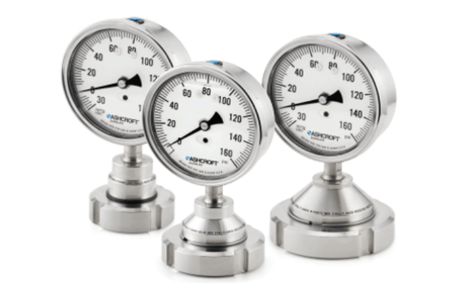 Sanitary gauges are pressure measurement devices specifically designed for applications that demand high levels of hygiene and cleanability.
Unlike standard industrial gauges, sanitary gauges feature smooth surfaces, crevice-free construction, and materials suitable for use in direct food, drug, or cosmetic contact.
Their purpose? To measure pressure without introducing contamination into sanitary processes.
For these gauges to be effective, they are used with food-grade, edible fill fluids such as food-grade glycerin or safe silicone blends. These fluids dampen vibration and maintain accurate readings even in high-temperature or high-vibration environments. If a diaphragm were to rupture, these edible fluids would not introduce toxic contamination if accidental contact occurred.
What Are Sanitary Pressure Gauges Made From?
The FDA requires all materials used in a food production process to be corrosion-resistant, non-reactive, and durable enough to withstand repeated washing. Sanitary gauges are primarily made from stainless steel because it checks all of those boxes. There are different grades of stainless steel used in various applications (Food Grade 304, Food Grade 316, Food Grade 430).
Hastelloy is another material option for applications that do not perform well with stainless steel.
Another vital component of a sanitary gauge is the sanitary seal or diaphragm mechanism. These seals allow the gauge to be used in systems with clean-in-place (CIP) or sterilize-in-place (SIP) requirements. Also made from stainless steel, the diaphragm and housing components ensure a sanitary, corrosion-resistant, and durable connection to the process.
Industries Served by MCE
Sanitary gauges are central to hygienic process control and widely used across industries where contamination could compromise safety or product quality. MCE supports customers in:
- Dairy processing
- Breweries and distilleries
- General food and beverage processing
- Pharmaceutical and biotechnology manufacturing
- Cosmetics manufacturing
- Research and university laboratories
These industries not only rely on sanitary gauges for measurement accuracy but also for regulatory compliance and consumer safety.
Common Challenges with Using Incorrect Industrial Gauges
Selecting the wrong gauge or using a non-sanitary gauge in a hygienic process can lead to serious operational and financial consequences. An incorrect gauge can compromise an entire batch, shut down production, or threaten regulatory compliance.
Compounding this issue, facilities often struggle with high employee turnover, which results in a gradual loss of knowledge about correct gauge selection, installation, and maintenance. Many customers reach out to MCE because:
- New employees don’t know which gauge types are required
- Improper gauges are being installed because they look similar
- Facilities fear falling out of regulatory compliance
Downside of Using Non-Sanitary Gauges in Food & Beverage Plants
When food and beverage facilities use standard gauges instead of sanitary gauges, contamination risk spikes. The threaded cavities in standard gauges can trap residue, leading to:
- Product contamination and potential batch loss
- Leaks under pressure (common when non-sanitary gauges corrode or fail at welded joints)
- Costly downtime to clean and sanitize affected lines
- Compliance issues with FDA and 3-A standards
MCE Customer Case Study
One of our customers, a major beverage plant, needed help overcoming failure from their use of a standard gauge. The gauge failed under pressure and leaked product, halting production and costing hundreds of thousands of dollars.
Their maintenance team reached out to MCE and provided photos of the gauge assembly. We recommended replacing their existing gauge with the Ashcroft 1032 sanitary gauge, eliminating future leaks and restoring compliance immediately.
Downside of Using Non-Sanitary Gauges in the Pharmaceutical Industry
In pharmaceutical facilities, any impurity introduced by a non-sanitary fitting can result in the entire batch being rejected. Standard gauges are not designed for clean-in-place (CIP) or sterilize-in-place (SIP) systems, increasing the risk for:
- Cross-contamination between runs
- Regulatory non-compliance and steep fines
- Loss of customer trust and high recall costs
MCE Customer Case Study
One of our pharmaceutical customers was using a standard pressure gauge that couldn’t withstand repeated sterilization cycles. The outdated, commercial-grade gauge they used was not designed for sterile environments, and as a result, the interior seals degraded, releasing particulates into the process stream.
We recommended switching to the Ashcroft 1032 sanitary gauge to correct the issue and ensure long-term process integrity.
Cost of Failure vs. Cost of Prevention
Don’t let a ~$400 part shut down a $40,000 batch.
A failed gauge might cost hundreds to replace, but when it comes to contamination or downtime, the true costs run into the tens of thousands (or more) in lost production, labor, and wasted product.
Using incorrect gauges leads to:
- Wasted product
- Production downtime
- Emergency equipment replacements
- Additional labor expenses
- Regulatory exposure
- Reputation damage
Many customers see substantial savings simply by moving from low-cost commercial gauges to industrial-grade sanitary models designed for hygienic environments. Investing upfront in high-quality sanitary gauges:
- Avoids contamination risks
- Ensures compliance
- Reduces long-term maintenance
- Improves equipment lifespan
- Protects product safety and brand integrity
For sanitary gauge recommendations, the Ashcroft 1032 Sanitary Pressure Gauge is an MCE favorite. The Ashcroft 1032 sanitary gauge prevents common failures, is designed in accordance with FDA and 3-A sanitary guidelines and has an EHEDG-compliant design.
Compliance and Certification Guidelines for Sanitary Pressure Gauges
Ashcroft developed their sanitary gauges to prevent product contamination and facilitate cleaning and sanitizing operations, meeting standards and guidelines such as:
- Good Manufacturing Practices (GMP). GMP regulations were established by the Food & Drug Administration (FDA) to prevent contamination and maintain product quality throughout the manufacturing process to protect public health.
- 3-A. The sanitary standards established by 3-A focus on the design, construction, and operation of food processing and equipment to ensure they meet a required level of sanitary safety.
- Restriction of Hazardous Substances (RoHS). Where applicable, RoHS regulates the use of certain hazardous substances, including polybrominated diphenyl ethers (PBDE), polybrominated biphenyls (PBB), hexavalent chromium (CrVI), cadmium (Cd), mercury (Hg), and lead (Pb), and certifies that these substances are NOT present in products or processes.
Tips on Selecting the Right Sanitary Gauge
Choosing the correct sanitary gauge is not a one-size-fits-all process. Each facility and application has unique requirements. Failing to consider them can have serious consequences.
MCE’s team of instrumentation experts guides our customers and their supply partners through a series of questions to identify the best solution for their needs. These questions can include:
- What process will the gauge be used for?
Different processes, such as dairy, brewing, pharma, and cosmetics, have different temperature profiles, cleaning methods, and material compatibility requirements. - What pressure range is needed?
Selecting too wide a range sacrifices accuracy, too narrow risks overpressure damage. - What certifications or calibrations are required?
Pharmaceutical manufacturers may require traceable calibrations, while food processors need documentation to show compliance with hygiene standards. - What is the appropriate material?
Choose materials that are compatible with the process media. Stainless steel is ideal for monitoring pressure in highly sensitive industries like food and beverage, pharma, and biotech because it is corrosion resistant and hygienic. Be sure to choose a gauge manufacturer that can provide documentation for material traceability. Sanitary pressure gauges should also have a smooth, non-porous finish with no crevices or areas where contaminants can accumulate. - Where will the gauge be installed in the process line?
Placement matters. Fermentation tanks, pasteurizers, filtration skids, and bottling lines present different mechanical and thermal stressors. - What cleaning methods are required?
Regular cleaning and sterilization of equipment is critical in sanitary processes. Be sure the pressure gauges you choose can meet clean-in-place (CIP) or sterilize-in-place (SIP) requirements.
Let’s Discuss Your Sanitary Pressure Gauge Needs
Customer Support and Expertise from MCE
Industry experience is our strong suit. We not only understand the products we sell, but we also have experience helping facilities like yours overcome real-world challenges occurring inside your plant every day.
Our team of sanitary instrumentation experts has decades of expertise in product knowledge, factory collaboration, training, and responsive customer support. Whether you operate a dairy plant, biotech facility, research facility, or pharmaceutical company, MCE can help ensure your process is safe, compliant, and efficient.