
eCommerce sales keep climbing, and nowhere is that more visible than during peak season. When order volumes surge and labor is stretched thin, every conveyor, scanner, and lifter in a warehouse becomes mission-critical.
Warehouses hustle to keep goods moving. But many operations are working with equipment never designed for today’s unpredictable spikes.
That’s the reality for many facilities: a mix of older conveyors, selective automation, and manual labor that has been stretched as far as it can go. Rebuilding an operation isn’t always practical, especially while orders are still rolling in. The challenge becomes how to modernize without starting from scratch.
Peak season exposes the weak points that stay hidden the rest of the year.
Modernizing Warehouses for Peak Season
The most dangerous breakdowns are the ones that happen in November and December. A stalled conveyor during peak season means lost sales, missed SLAs, and canceled customer promises.
In many cases, warehouses don’t need a full redesign; they’re trying to improve what they already have. A single replacement roller can keep a packing line running. A motorized zone upgrade can eliminate a bottleneck where boxes often back up. With incremental improvements, productivity rises long before major automation is considered.
MCE helps fulfillment operations take a phased approach. The team works from customer-supplied specs and can quote retrofit upgrades that convert manual or gravity systems into powered, zero-pressure accumulation conveyors, all without requiring onsite consulting unless the project calls for it. The equipment that already exists becomes more reliable, more responsive, and more aligned with what peak-season flow demands.
Over time, these improvements stack up to a system that behaves less like legacy equipment and more like a modern fulfillment line.
Extending the Life of the Systems That Matter Most
Many fulfillment centers ride into peak season relying on conveyors that may have already exceeded their expected lifespan. If those systems go down during critical weeks, every hour of delay compounds. Waiting days for OEM responsiveness isn’t an option when orders are pouring in.
That’s why having fast access to the right belts, rollers, and trolley components can be the difference between a record year and a recovery plan.
MCE keeps these systems moving. Many facilities come to us for replacement belts, clips, and subcomponents that keep Portec curved conveyors in service. Others rely on MCE for parts and expert guidance for Daifuku/Jervis Webb overhead and Unibilt systems — equipment with fewer active suppliers supporting it in the U.S.
Maintaining this installed base protects operational continuity while giving teams more time to plan what their next evolution looks like.
 Making Warehouse Space Work Harder
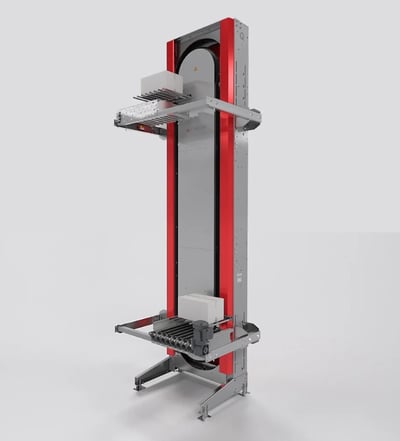
Peak demand doesn’t wait for building expansion; it only demands more from the footprint you have. Using vertical movement to open space above the floor is one of the fastest ways to scale without adding real estate or re-routing aisles during your busiest weeks.
Floor space is increasingly expensive. As SKUs multiply and seasonal peaks surge, fulfillment centers can’t just spread out. They have to build up.
By integrating conveyors with vertical lifters from Qimarox, MCE supports more efficient picking, put-away, and staging. And when those lines are complemented with sensors, logic, and scanning technology, operators gain the visibility needed to keep orders moving without interruption.
It’s not automation for its own sake. It’s targeted coordination that ensures product flows smoothly from receiving to shipping, even as order volumes shift.
Support That Keeps Teams Productive
Fulfillment teams know exactly when a conveyor will fail: right when they need it most. Having a partner who can quickly identify the correct replacement part — even for systems installed decades ago — keeps peak season on track.
MCE provides that continuity. Customers know they can get rollers, drives, and controls for multiple OEM brands through a partner who understands the systems well enough to help ensure the right part arrives the first time. That kind of support helps operations teams stay focused on throughput and not troubleshooting.
When Reliability Matters Most
Peak season won’t wait. The operations that thrive are those that steadily build reliability, space efficiency, and automation capacity all year long. When the busiest stretch arrives, they’re ready for it.
Our role is to help make that possible, strengthening the systems that are already working, extending the life of legacy equipment that still plays a critical part in the process, and connecting the right technologies to support the way fulfillment must operate today.
Because in an environment where orders never slow down, the systems that keep them moving can’t slow down either.